
Most Americans lost the moving expense tax deduction back in 2018. But if you are on active duty and you move under military orders, you are the big exception. The military moving expenses tax deduction is still on the books, and it can put real money back in your pocket at tax time. This guide explains who qualifies, what you can write off, and what the government already pays for so you do not double-dip by mistake.
A PCS (Permanent Change of Station) move is stressful enough without tax confusion on top of it. Let's keep this simple.
Who Still Qualifies for the Deduction?
The Tax Cuts and Jobs Act of 2017 suspended the moving expense deduction for almost everyone through 2025. The law kept one group in place: members of the Armed Forces on active duty who move because of a military order and a permanent change of station. According to the IRS, if you meet that test, you can still deduct your unreimbursed moving costs.
You do not have to itemize to claim it. The deduction is an adjustment to income, which means you can take it and still use the standard deduction. That is a nice bonus, because most military families do not itemize.
One key word above is "unreimbursed." You can only deduct costs you actually paid out of your own pocket. Anything the government paid for, or paid you back for, is off the table. More on that below.
What You Can Deduct
The IRS spells out the deductible costs in the Form 3903 instructions. For a move within or to the United States, you can generally deduct:
- The cost to pack, crate, and move your household goods and personal belongings.
- The cost to store and insure those belongings within any 30 days in a row after they leave your old home and before they reach your new one.
- Travel and lodging for you and your family as you go from your old home to your new one. This includes airfare or the cost of driving your own vehicle.
If you drive your own car, you have two choices. You can track your actual gas and oil costs, or you can use the standard mileage rate. For 2025, the IRS moving mileage rate is 21 cents per mile. The IRS sets a new rate each year, so check the current figure before you file.
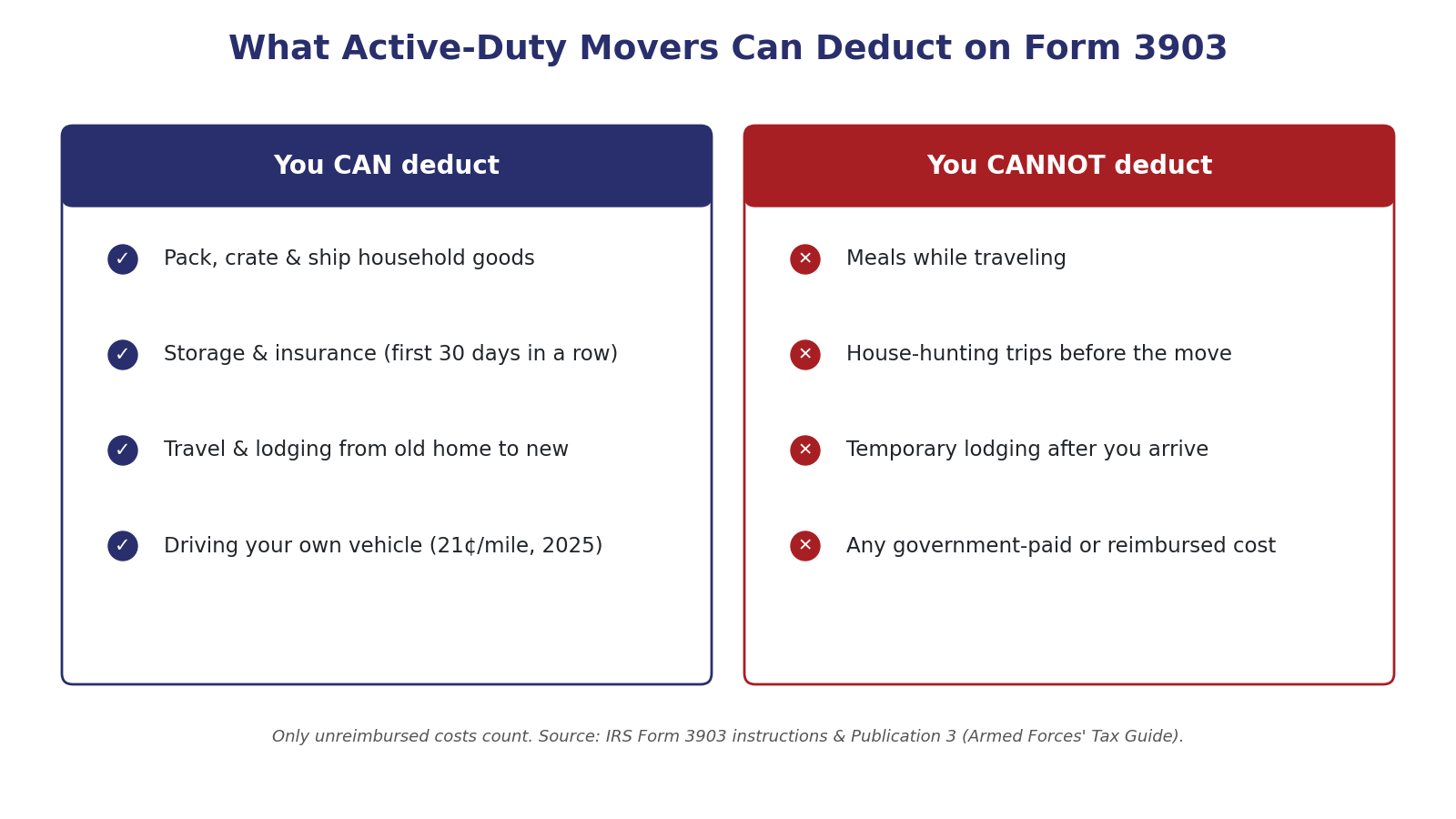
What the IRS lets active-duty movers deduct on Form 3903, and what it does not. Source: IRS Form 3903 instructions and Publication 3.
What You Cannot Deduct
This is where many families slip up. You cannot deduct anything the military already handled or paid you for. That means:
- Any moving or storage service the government provided, such as a standard household goods shipment booked through the transportation office.
- Any cost that a government reimbursement or allowance already covered and that was left out of your taxable income.
- Meals while you travel. Lodging counts, but meals never do.
- House-hunting trips before the move and the cost of temporary lodging once you arrive.
Think of it this way. If the money came from a moving allowance, a mileage payment, or a per diem, you were already made whole, so you do not get to deduct it again. Your deduction is for the true out-of-pocket gap. To see which parts of your move come with reimbursements in the first place, read our guide to understanding your PCS entitlements and benefits.
How Reimbursements and a PPM Change the Math
Because the government moves most of your household goods for free and pays you for travel, the deduction often applies to a smaller set of costs than people expect. It tends to matter most when you spend your own money and are not fully paid back.
A common example is a PPM, or personally procured move, sometimes still called a DITY (do-it-yourself) move. When you handle your own move, the government pays you an incentive based on what it would have cost them. If your real costs run higher than what you were paid and reimbursed, that unreimbursed gap may be deductible. Our guide on how to maximize your PPM incentive walks through that payment, and our explainer on PCS travel pay, mileage, and per diem covers what you are owed for the drive itself.