You signed a lease, you have the keys, and your household goods are three states away with no delivery date. A PCS inconvenience claim is the payment the moving company owes you for exactly that situation, and in 2026 it got meaningfully bigger for families. Since May 15, 2026, your dependents count toward the payment too.
This is not the same thing as a damage claim, and it is not an entitlement paid by the government. It is money paid directly to you by the moving company for failing to hit the dates it agreed to. Here is when it applies, what it pays, and how to file.
When You Qualify
According to the Defense Department's inconvenience claims fact sheet, a claim is authorized when one of these happens.
- The moving company fails to pick up your shipment on the agreed date.
- The moving company fails to deliver on or before the required delivery date, and you have possession of a residence and are available to receive delivery.
- The company puts your shipment into storage in transit at destination without first making and documenting two unsuccessful attempts to reach you, at least six hours apart.
- You ask for delivery out of storage in transit and the company cannot deliver within seven government business days of your first request.
- You request a delivery date more than seven government business days out and the company cannot deliver within two government business days after that date.
The required delivery date, usually written as RDD, is the date on your shipment paperwork by which the company has to deliver. It is the number the whole claim turns on, so find it before you call anyone.
One term to know: storage in transit, or SIT, is the temporary storage the government pays for during a move. If your shipment is sitting in SIT at destination, the 90-day SIT rules run alongside your inconvenience claim.
When You Do Not Qualify
The company is off the hook when the delay is caused by something outside its control.
- Natural disasters, acts of a public enemy, or violent strikes
- Acts of the U.S. government, such as a customs inspection
- You or your representative not being available for a delivery scheduled before the required delivery date
- A shipment consisting entirely of alcohol
- Mold or infestation found at pickup, though liability can resume after it is cleaned up
You also cannot file an inconvenience claim on a direct procurement method shipment, and an inconvenience claim has nothing to do with your loss and damage claim. Those are two separate files with two separate processes. If your things also arrived broken, file a PCS damage claim on top of this one.
What It Pays, and the 2026 Dependent Change
Reimbursement is based on the meals and incidental expenses per diem rate, usually written as M&IE, for the location where you are stuck. This is the biggest change in years.
- Shipments picked up before May 15, 2026: the service member only, at 100% of the local M&IE rate.
- Shipments picked up on or after May 15, 2026: the service member at 100% of the local M&IE rate, plus every dependent traveling on approved, funded orders at 75% of the rate.
For a family of four sitting at the standard continental U.S. rate, that is a large difference. The General Services Administration set the fiscal year 2026 standard M&IE rate at $68 per day, unchanged from the prior year and effective October 1, 2025.
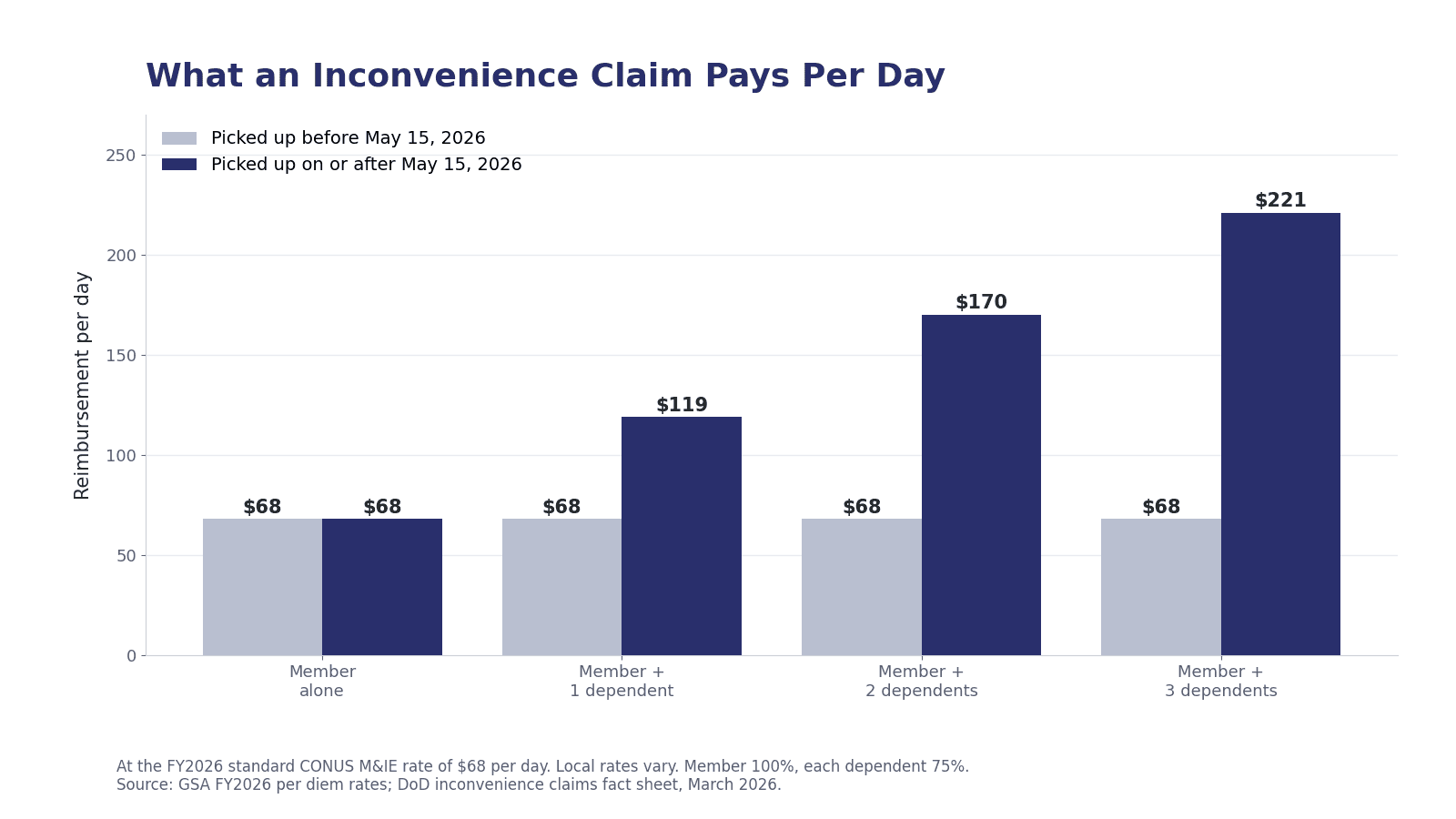
Daily reimbursement at the FY2026 standard M&IE rate of $68. Rates vary by location. Source: GSA FY2026 per diem rates and the DoD inconvenience claims fact sheet, March 2026.
Look up your actual location rate on the Defense Travel Management Office per diem page rather than assuming the standard rate. High-cost areas near many installations run well above it.
For the first seven days you can take the per diem without submitting receipts. If your real out-of-pocket costs were higher, you can submit receipts for those seven days instead and get paid the actual amount. Starting on the eighth day, per diem stops and you have to submit receipts either way.
Unaccompanied baggage is different. Those claims are always paid on actual documented expenses, never per diem.
Expenses Beyond Per Diem
In some situations you can be reimbursed for more than the daily rate. The fact sheet lists examples.
- Rental of furniture or appliances, including a television
- Rental of special medical equipment for you or your approved dependents
- Extra housing costs above your Basic Allowance for Housing, the monthly housing stipend known as BAH, when a missed pickup forces you to extend a lease
Groceries and alcohol are not reimbursable. Lodging and meals usually are not either, though a company may approve short-term lodging case by case. Every one of these needs an itemized list and receipts, and you should ask the company what qualifies before you spend the money.