If you have orders for a PCS to Fort Bragg, welcome to central North Carolina. PCS stands for Permanent Change of Station, the military term for moving from one duty station to another. Fort Bragg sits next to Fayetteville, in Cumberland and Hoke counties, in the Sandhills region of the state. You may have seen this post called Fort Liberty. It carried that name from 2023 to 2025, and on February 14, 2025 the Army restored the name Fort Bragg. The current name honors Private First Class Roland L. Bragg, a World War II paratrooper who earned the Silver Star and Purple Heart at the Battle of the Bulge, not the Confederate general the post was first named for, according to the U.S. Army.
A move is a lot to manage at once. Our goal is to make the Fort Bragg part feel clearer. This 2026 guide covers where to live, how housing pay works, schools, healthcare, the local climate, and a few things to do once you are settled.
What and Where Is Fort Bragg?
Fort Bragg is a U.S. Army installation in central North Carolina, next to the city of Fayetteville. It stretches across Cumberland and Hoke counties in the Sandhills, a region of sandy terrain and longleaf pine forests.
According to the U.S. Army Garrison Fort Bragg, the post is the Home of the Airborne and Special Operations Forces and one of the largest military installations in the world. It is home to the XVIII Airborne Corps, the Army's rapid-deployment headquarters; the 82nd Airborne Division, which provides the nation's quick-reaction parachute force; and U.S. Army Special Operations Command, known as USASOC, which includes the John F. Kennedy Special Warfare Center and School, where the Army trains its Special Forces. In plain terms, this is a large, fast-moving post with a deep airborne history and a strong community.
Where to Live When PCSing to Fort Bragg
Some families who move to Fort Bragg live in on-post housing, while others settle in Fayetteville or one of the surrounding Sandhills communities. On-post housing may have wait lists, so ask your sponsor and the housing office early. For off-post living, your choice usually comes down to commute, schools, and budget.
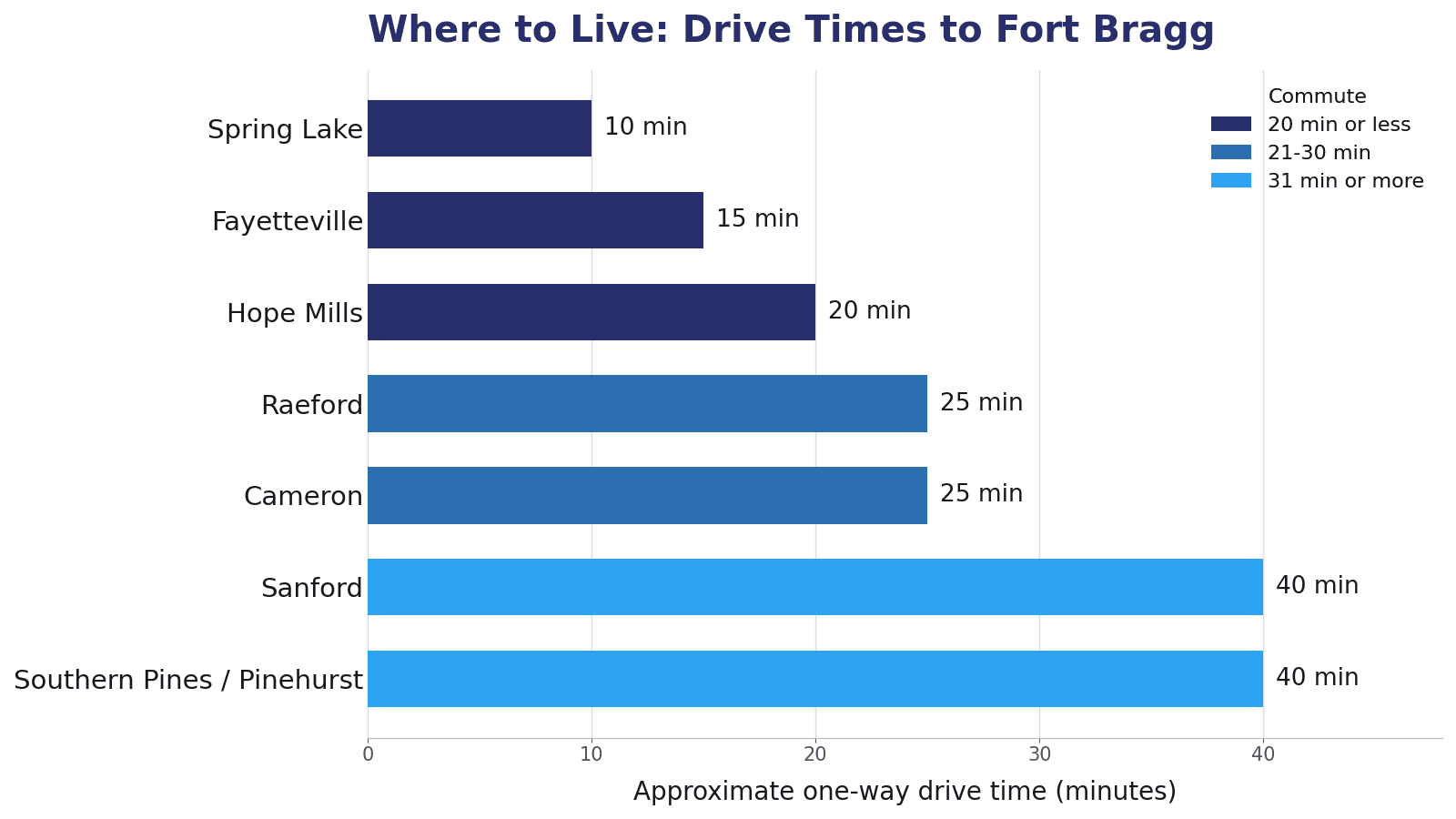
Approximate one-way drive times to Fort Bragg. Times vary with traffic and which gate you use.
Spring Lake
Spring Lake sits at the north edge of the post, often about 10 minutes from a gate. It is a small town with a tight military connection, established neighborhoods, and rentals close to base. Many families pick it for the short commute and easy access to the airborne side of the installation.
Fayetteville
Fayetteville is the large city that wraps around much of the post, with many neighborhoods around 15 minutes from a gate. It offers the widest range of homes, shopping, and services in the area. It is the most common choice simply for its size and variety.
Hope Mills
Hope Mills lies just south of Fayetteville, roughly 20 minutes from the post. It has a quieter, suburban feel, a popular lake and park, and family-friendly neighborhoods. Many families like it as a calmer base close to the city.
Raeford
Raeford is the seat of Hoke County, west of the post and about 25 minutes from a gate. It is more rural and often offers more home and land for the money, which draws families watching their budget.
Cameron
Cameron sits northwest of the post near the Harnett and Moore county line, about 25 minutes from a gate. It is rural and spread out, with larger lots and a country feel for families who want more space.
Sanford
Sanford is north of the post in Lee County, roughly 40 minutes away by way of U.S. 1. It is a growing small city with its own downtown, jobs, and generally lower home prices. The commute is longer, but some families like the trade for the value.
Southern Pines and Pinehurst
Southern Pines and Pinehurst sit west of the post in Moore County, about 40 minutes from a gate. The area is known for golf, walkable downtowns, and well-regarded schools, and home prices tend to run higher. It suits families who can absorb the longer commute.
If you have children, note that families living on the post are zoned to the on-post Fort Bragg schools, run by the Department of Defense, while families living off post fall under the local civilian districts. We cover both below.
Fort Bragg BAH and the Cost of Living
If you live off post, the military helps cover your housing through BAH, which stands for Basic Allowance for Housing. BAH is a monthly, tax-free payment. The amount depends on three things: your rank, whether you have dependents, and your duty station's Military Housing Area, or MHA. An MHA is the geographic zone the Defense Department uses to set local housing pay. Fort Bragg falls within the Fort Bragg, North Carolina Military Housing Area.
Because rates change each year and vary by rank and dependent status, we do not publish a rate table here. To find your exact figure, use the official DoD calculator: travel.dod.mil BAH Rate Lookup. Enter your rank and ZIP code to see the current rate, and confirm it before signing a lease or making an offer.
Central North Carolina and the Sandhills are a more affordable market than many duty stations, which is good news for families on a budget. The typical home value in Fayetteville was about $199,000 in June 2026, according to Zillow. That is a typical value, not a median sale price. As of the week of June 18, 2026, Freddie Mac reported the average 30-year fixed mortgage rate at 6.47 percent. Whether buying or renting makes more sense depends on how long you expect to be stationed here, so run the numbers for your own situation.
Schools Near Fort Bragg
The schools your children attend depend on where you live. The post and the surrounding civilian communities are served by different systems.