If you have orders for a PCS to Fort Jackson, welcome to the South Carolina midlands. PCS stands for Permanent Change of Station, the military term for moving from one duty station to another. Many people know Fort Jackson as the place where new Soldiers go through BCT, which stands for Basic Combat Training. It is the Army's largest BCT installation, but it is also a permanent-duty station with thousands of staff, instructors, and support personnel who live and work in the Columbia area. This 2026 guide is written for the permanent-party families who are moving here to call it home.
A move is a lot to manage at once. Our goal is to make the Fort Jackson part feel clearer. We will cover where to live, how housing pay works, schools, healthcare, the local climate, and a few things to do once you are settled.
What and Where Is Fort Jackson?
Fort Jackson sits inside the city of Columbia, in Richland County, South Carolina. It is the state capital region, often called the midlands, set between the coast and the mountains. Because the post is within the city, several in-town neighborhoods are only a short drive from the gates.
Fort Jackson is the U.S. Army's main center for Basic Combat Training. According to U.S. Army Fort Jackson, it is the Army's largest and most active Initial Entry Training center and trains roughly half of all Soldiers entering the Army each year, along with most of the women who join. The post has a long history that goes back to 1917, when the War Department approved an Army training center at Columbia, as the Fort Jackson history page explains.
The installation is also home to several training schools. Per the Fort Jackson units and tenants directory, these include the Soldier Support Institute, the Armed Forces Chaplaincy Center, and the U.S. Army Drill Sergeant Academy, which trains the noncommissioned officers who become drill sergeants. In plain terms, this is a large, busy installation with a strong community and a deep training mission.
Where to Live When PCSing to Fort Jackson
Permanent personnel may have access to on-post housing, so ask your sponsor and the housing office about current options and wait times. Many families also settle in one of the surrounding communities. Because the post is inside Columbia, your choice usually comes down to commute, schools, and budget more than distance.
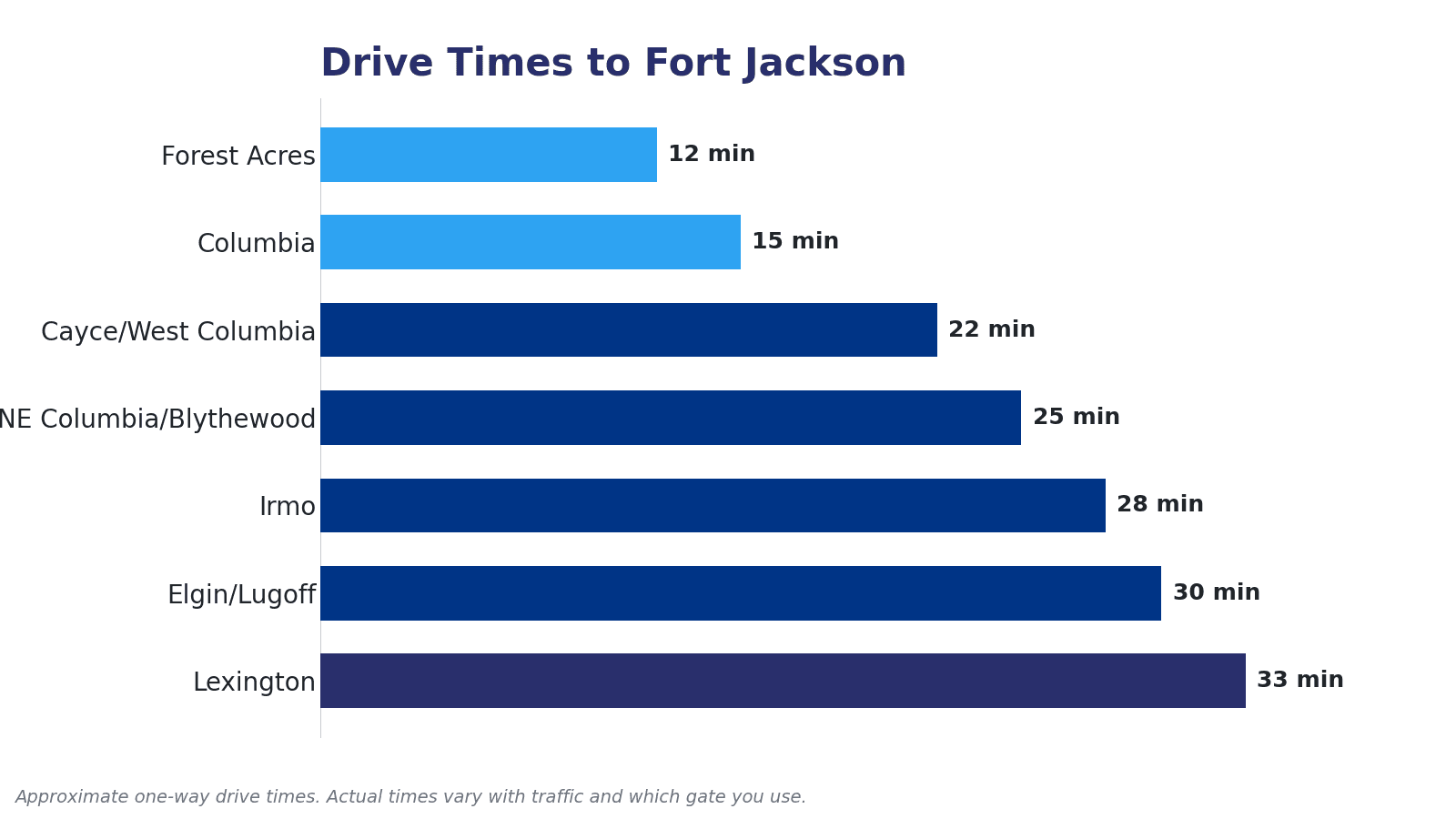
Approximate one-way drive times to Fort Jackson. Times vary with traffic and which gate you use.
Columbia
Columbia is the city the post sits inside, so many neighborhoods are very close, often 10 to 20 minutes from a gate. You get the full range of a capital city: downtown, the University of South Carolina, shopping, restaurants, and housing from older homes to newer subdivisions. It is a strong choice if you want short commutes and amenities nearby.
Forest Acres
Forest Acres is a small, established city tucked inside the Columbia area, about 10 to 15 minutes from the post. It is known for tree-lined streets, settled neighborhoods, and an easy drive to the gates. Many families like the close commute and the in-town feel.
Northeast Columbia and Blythewood
The Northeast Columbia and Blythewood area sits north of the post and has grown quickly, with many newer neighborhoods, good shopping, and well-regarded schools. Plan on roughly 20 to 30 minutes to the gate, a little more from Blythewood. It is popular with families who want newer homes.
Lexington
Lexington is west of Columbia, near Lake Murray, and runs about 30 to 35 minutes from the post depending on traffic. It is a popular suburban area with newer subdivisions, lake access, and strong schools. The trade-off is a longer drive across the city.
Elgin and Lugoff
Elgin and Lugoff sit northeast of the post in Kershaw County, roughly 25 to 35 minutes away. They are more suburban and rural, and they can offer more home and land for the money. Weigh the extra drive against the savings.
Cayce and West Columbia
Cayce and West Columbia are just southwest of downtown, across the river, about 20 to 25 minutes from the post. They offer a mix of older and newer homes, riverfront parks, and easy interstate access. It is a practical middle-ground option.
Irmo
Irmo is northwest of Columbia toward Lake Murray, about 25 to 30 minutes from the post. It is a settled suburb with good schools and plenty of shopping, and it draws families who want a quieter pace with the lake close by.
Fort Jackson BAH and the Cost of Living
If you live off post, the military helps cover your housing through BAH, which stands for Basic Allowance for Housing. BAH is a monthly, tax-free payment. The amount depends on three things: your rank, whether you have dependents, and your duty station's Military Housing Area, or MHA. An MHA is the geographic zone the Defense Department uses to set local housing pay. Fort Jackson falls within the Columbia, South Carolina Military Housing Area.
Because rates change each year and vary by rank and dependent status, we do not publish a rate table here. To find your exact figure, use the official DoD calculator: travel.dod.mil BAH Rate Lookup. Enter your rank and ZIP code to see the current rate. Exact BAH rates are verified separately, so always confirm yours before signing a lease or making an offer.
For a sense of buying costs, the typical home value in Columbia was about $222,000 in June 2026, according to Zillow. That is a typical value, not a median sale price. As of the week of June 18, 2026, Freddie Mac reported the average 30-year fixed mortgage rate at 6.47 percent. Whether buying or renting makes more sense depends on how long you expect to be stationed here, so run the numbers for your own situation.