
Every service member hopes for a long lead time before orders drop. Sometimes you get 30 days or less. A short-notice PCS move (Permanent Change of Station, the military's term for relocating to a new duty station) is stressful, but it is manageable with a plan. This guide breaks the next 30 days into four weeks so you always know the single most important thing to do next. Work it top to bottom and you will land on your feet.
What Counts as a Short-Notice PCS Move?
A short-notice PCS move is any relocation where you have only a few weeks between receiving orders and your report date. The military moving system is built for more lead time, so the two things that bite hardest are moving-truck availability and housing. During peak PCS season, roughly May through August, both fill up fast. The fix is to act on the highest-leverage items first and let the smaller tasks follow.
If you have never done this before, keep our ultimate PCS checklist and timeline open in another tab. This guide is the fast-track version of that plan.
Week 1 (Days 30 to 22): Lock In the Basics
The first week is about paperwork and dates. Nothing else can move until these are set.
- Get your orders in hand and read them closely. Confirm your report date, whether the move is CONUS (within the continental United States) or OCONUS (overseas), and any restrictions.
- Visit your installation's transportation office or the official DoD moving site at move.mil to start your move. Choose between a government-arranged move, where movers pack and haul your household goods (HHG), or a PPM (Personally Procured Move, once called a DITY or do-it-yourself move) where you move yourself for a payment.
- Book your moving dates immediately. On a short timeline, the calendar is your scarcest resource. If no government mover is available, a PPM may be your fastest path.
- Start a digital folder for orders, receipts, and confirmation numbers. You will need them for reimbursement later.
Week 2 (Days 21 to 15): Housing and Money
With dates locked, turn to where you will live and how you will pay for the move.
- Line up housing at the new base. On a fast move, most families rent first and buy later, but you can still start the search now. If buying is on the table, get a lender working on your pre-approval this week.
- Ask your command about permissive TDY for house hunting. This is typically up to 10 days of leave that is not charged against your balance, granted after you receive orders. Our house-hunting leave guide explains how it works.
- Plan your temporary lodging. TLE (Temporary Lodging Expense) reimburses part of your lodging and meal costs while you are in temporary quarters during a CONUS move, for up to 14 days, per Military OneSource's TLE page. See our temporary lodging expense guide for the details.
- Ask finance about advance pay and allowances. You may be able to request advance basic pay and receive your Dislocation Allowance (DLA), a one-time payment that helps offset the cost of relocating, so cash is not the thing that stalls your move.
If you must choose a home before you can visit in person, read our guide to buying a home sight unseen during a PCS move so you know how to protect yourself.
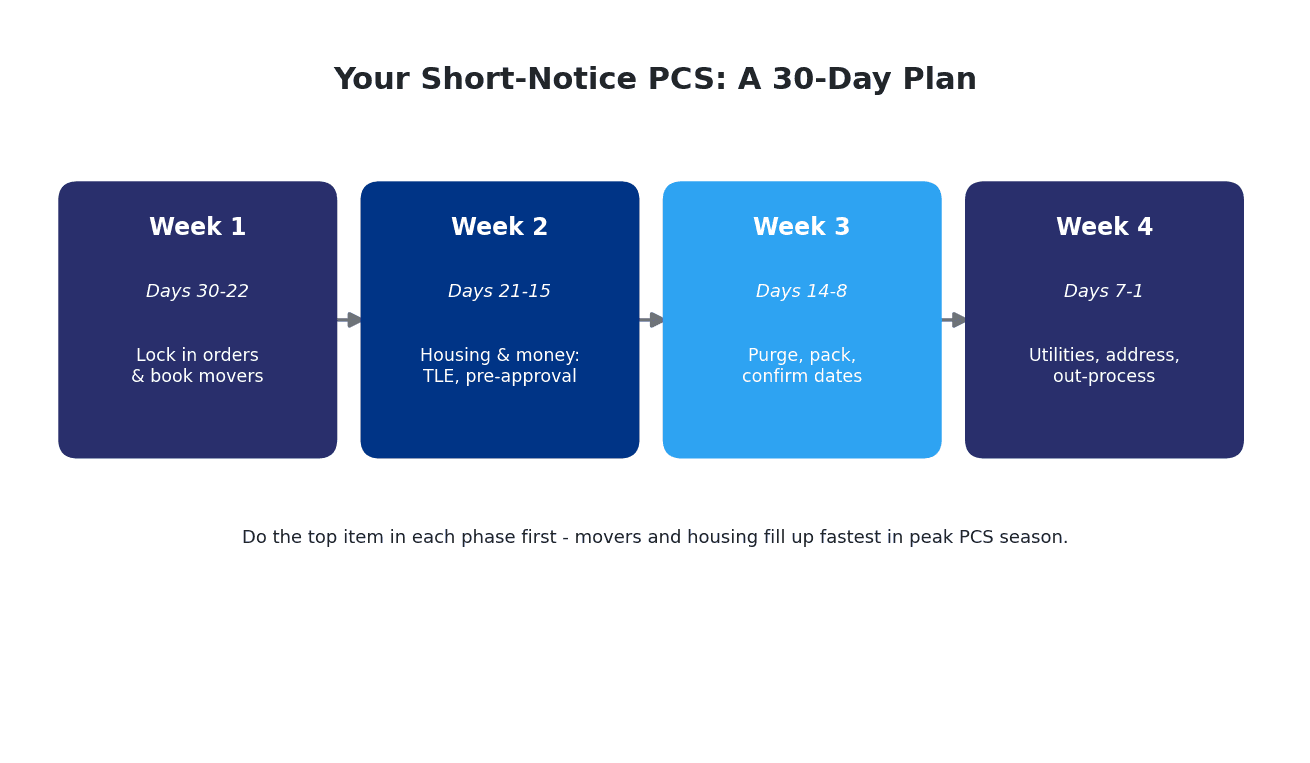
A short-notice PCS in four one-week phases. Do the top item in each phase first.
Week 3 (Days 14 to 8): Pack, Sort, and Confirm
Now the house gets real. This week is about lightening the load and confirming every appointment.
- Purge before you pack. Fewer belongings mean a faster pack-out and a cleaner PPM weight ticket. Donate or sell what you will not miss.
- Learn what movers will not touch. Some items are not allowed on the truck, from certain chemicals to open food. Our guide to what military movers won't pack helps you plan those separately.
- Confirm your pack and pickup dates in writing. On a short timeline, a missed confirmation can cost you days you do not have.
- Set aside a "first-night" box: documents, medications, chargers, a few clothes, and anything your kids or pets need right away.