

PCS vehicle shipping is one of those parts of a military move families assume is covered, right up until it is not. A PCS, short for Permanent Change of Station, moves your household goods at government expense. Your car sits under a separate rulebook. Shipping a car during a PCS is fully paid in some cases, partly paid in others, and entirely on you in the rest.
What the Government Pays For
A POV, or privately owned vehicle, is any vehicle or motorcycle registered to you for personal use. That is how the Department of War Personal Property Activity, the office that runs military moves, defines it in its official guide to shipping your POV.
The entitlement comes down to one split.
- CONUS means inside the continental United States, the lower 48 states. Between two CONUS duty stations, the government expects you to drive.
- OCONUS means outside the continental United States, including overseas locations plus Alaska and Hawaii. To, from, or between OCONUS duty stations, the government will generally pay to ship one POV you own or lease.
Those rules live in the Joint Travel Regulations, or JTR, the rulebook for military travel allowances. Paragraph 0529 covers CONUS shipment, 0530 covers OCONUS shipment, and 0532 covers POV storage. One car, not one per driver.
Moves Inside the United States: Plan to Drive
For a normal CONUS-to-CONUS move there is no free car shipment. You are paid to drive instead, through Monetary Allowance in Lieu of Transportation, or MALT, a per-mile rate paid on top of a per diem for food and lodging on travel days.
The rate changes, sometimes twice a year. Look up the current figure on the Defense Travel Management Office mileage rates page, and see our guide to PCS travel pay, mileage, and per diem for how the two stack.
There are narrow exceptions. Under JTR paragraph 0529, POV transportation inside CONUS may be authorized when a ship's home port officially changes, or when the member is physically unable to drive or lacks the time to drive and still report when orders require. Ask your personal property office and get approval in writing first.
You can also hire a carrier yourself. Shipping at your own expense does not usually cost you the MALT and per diem, though confirm that against your orders. Private quotes swing widely, so collect at least three.
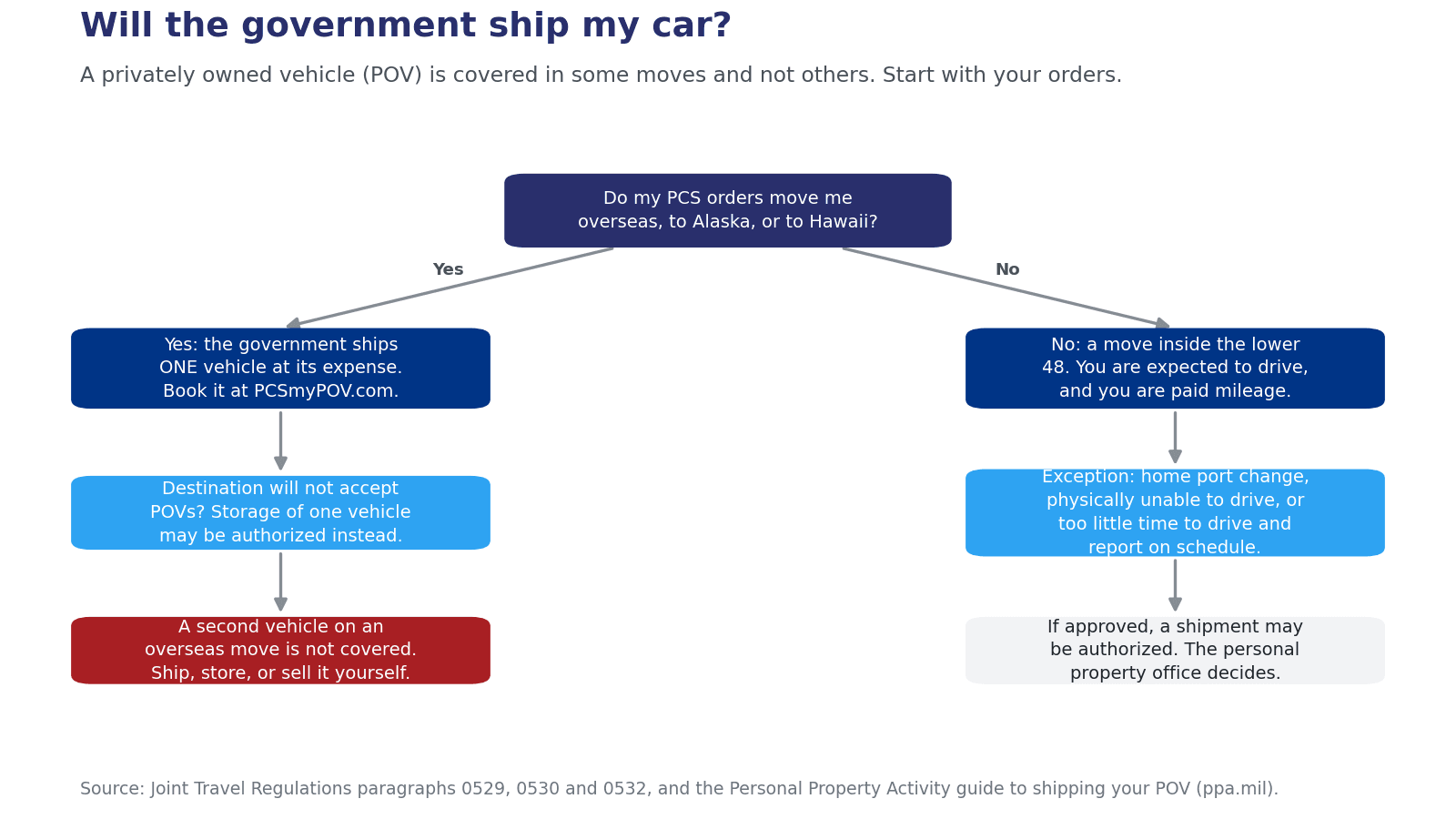
Start at the top with your orders. Source: JTR paragraphs 0529, 0530, and 0532, and the PPA POV guide.
Moves Overseas: One Car, One Contractor
OCONUS shipments run through one contractor, International Auto Logistics, and one booking site, PCSmyPOV.com. That is where you find your vehicle processing center, or VPC, see the current document list, and schedule your appointment. Every turn-in and pickup is by appointment.
A few limits matter as you plan an overseas PCS.
- The government ships a vehicle up to 20 measurement tons. Anything bigger and you sign for the excess cost.
- Some aftermarket modifications are illegal in the destination country or trigger special handling. Ask your personal property office first.
- Dual-military couples are generally each entitled to ship one POV when both are on orders. Confirm it rather than assuming.
- A car bought overseas often fails United States standards, so check import rules first.
- If the destination will not accept POVs, JTR paragraph 0532 may authorize storing one vehicle at government expense instead. Choose a commercial lot that charges above the government rate and you pay the difference.
PCS Vehicle Shipping at a Glance
| Your situation | Paid by the government? | What to do |
|---|---|---|
| CONUS to overseas, Alaska, or Hawaii | Yes, one POV | Book on PCSmyPOV, turn in at a VPC |
| Between two overseas duty stations | Yes, one POV | Confirm the country permits your vehicle |
| Between two stations in the lower 48 | No, you drive | Claim MALT plus per diem |
| CONUS move, unable to drive or no time | Possibly | Request approval under JTR 0529 |
| Second car, CONUS move with dependents | Partly | Share is capped; you pay the rest |
| Second car, OCONUS move | No | Ship, store, or sell it yourself |
| Overseas tour where POVs are barred | Storage, not shipping | Ask about storage under JTR 0532 |
A VeteranPCS agent at your next duty station can tell you what the commute is really like from the neighborhoods you are weighing, which matters more when your car is at sea.
Step by Step: The Vehicle Processing Center
The process is simple but unforgiving about paperwork and vehicle condition.
- Book your turn-in appointment on PCSmyPOV.com as soon as orders are in hand.
- Bring proof of ownership: current registration, a copy of the title, a bill of sale if you bought the car within 90 days, or written export approval from your lienholder.
- If the car is financed or leased, request that lienholder letter early. It is the most common delay.
- Bring a complete set of orders with all amendments and a government-issued photo ID.
- If someone else drops the car off, bring a power of attorney or letter of authorization, plus one from every person on the title.
- Clear open safety recalls with proof. Brakes must work, tires must be safe, the windshield must have no major cracks, and nothing may leak.
- Arrive clean inside and out with a quarter tank of fuel or less. A full tank gets you sent home.
- Strip out every personal item. Only things needed for normal operation or passenger safety stay: spare tire, jack, jumper cables, first-aid kit, child car seats.
Planning Your Next Move?
Connect with Veteran & Military Spouse Real Estate Agents and VA Loan Experts You Can Trust.
Your car is not a shipping container, and packed items are not covered.
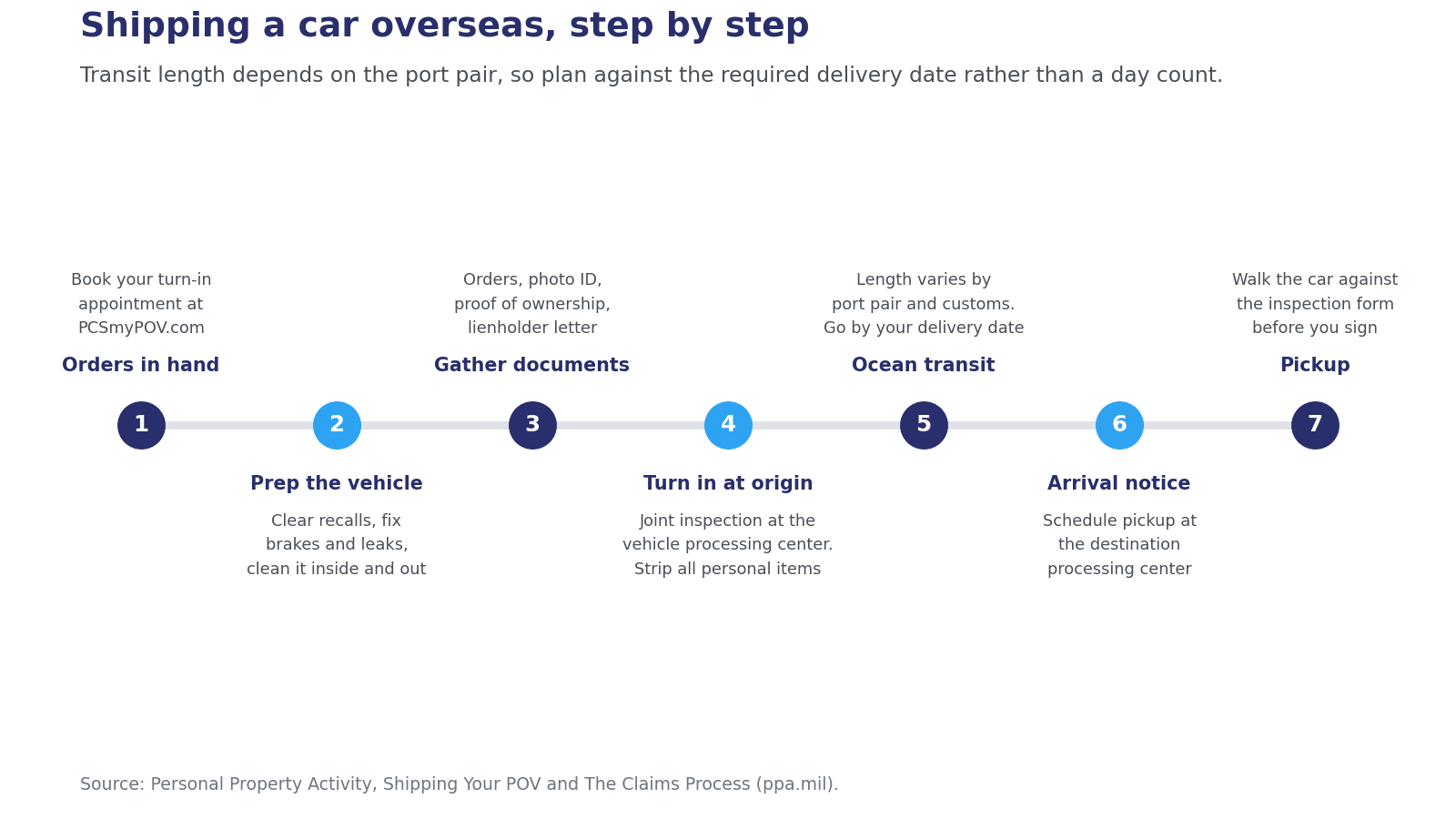
The overseas POV process, from booking to keys back in your hand. Source: PPA guide to shipping your POV.
At the destination VPC you will be told when the car arrives and asked to schedule pickup. Walk the whole car before you drive off and note anything missing from the inspection form. Batteries often die on a long shipment, and the VPC can jump-start you.
The Second Car, the Motorcycle, and the Boat
On a CONUS move, a member with dependents may be authorized to ship a second POV, but the terms are tight. Under JTR Table 5-63 the dependents must be eligible for transportation and relocating with you, you must own more than one vehicle that has to move, and everyone must travel together in the one car you drive. The government's share is capped at whatever is left of the MALT plus per diem for driving two cars.
On an OCONUS move there is no second-vehicle entitlement. You ship it, store it, or sell it yourself.
Motorcycles and dirt bikes can sometimes ride inside your household goods shipment instead of shipping as a separate POV, but your personal property office must authorize it.
Boats and trailers are a household goods question. Their weight counts against your allowance, and special crating or handling fees are on you. Small boats that fit a standard overseas container move with your household goods, and larger ones go through a separate one-time-only process. Check the math against our PCS weight allowance guide first.
Non-operational vehicles are out. The VPC will not accept a car that cannot be driven on and off a ship.
If Your Car Arrives Damaged
POV claims do not go through the household goods claims system. International Auto Logistics handles them, and the deadline is short. Per the Personal Property Activity claims guidance, you have 10 business days after picking up your POV to file a loss or damage claim. For minor damage under $1,500 you may be offered an onsite settlement at the VPC, which is fastest. For anything larger, get a repair estimate and submit a formal claim to the contractor. If you cannot settle directly, transfer the claim to your branch's Military Claims Office.
A separate inconvenience claim covers a rental car if your vehicle misses its required delivery date. When the contractor is at fault, rental costs are covered from the first day it is late until they tell you it is ready. Ask VPC staff for the claims pamphlet at pickup.

Free First-Time Homebuyer Guide
Make your move less stressful with our step-by-step first-time homebuyer guide.
We respect your privacy. Unsubscribe anytime.Photograph the car from every angle at turn-in and at pickup. Time-stamped photos settle arguments paperwork will not.
Going Without a Car Changes Your House Hunt
If your car is on a ship, you are shopping for a home without one. You end up relying on rides, rentals, or a spouse's schedule, and weekend tours across a metro area become a real problem. Families in this spot often settle for the first place they can physically reach, which is a bad reason to sign an offer.
Two things help. Line up your house hunting leave for a window when you actually have wheels, and use an agent who can walk homes on video when you do not. Our guide to buying a home sight unseen during a PCS covers doing that carefully. Watch the other end of the timeline too: if your household goods land before you do, the storage in transit clock is already running.
A VeteranPCS agent has made this move and can preview homes, drive the commute, and send you honest video before you ever land. Connect with an agent at your next duty station at no cost to you.
Frequently Asked Questions
Will the military ship my car for a CONUS move?
Usually no. Between two duty stations in the lower 48, the government expects you to drive and pays MALT plus per diem. JTR paragraph 0529 allows shipment at government expense in narrow cases: an authorized change in a ship's home port, or when you are physically unable to drive or lack the time to drive and still report on schedule. Those need approval from your personal property office.
Can I ship two cars?
Not at full government expense. On an OCONUS move the entitlement is one vehicle, though dual-military couples generally each get their own. On a CONUS move, a member with relocating dependents may ship a second car, but the government's share is capped at the leftover MALT and per diem for driving two.
How long does POV shipping take?
It depends on the port pair, ocean schedules, and customs at the destination, so go by the required delivery date the contractor gives you. If the car is late and the contractor is at fault, rental costs are covered from day one.
What can I leave in the car?
Very little. Only items needed for normal operation or passenger safety: spare tire, jack, jumper cables, first-aid kit, child car seats. Everything else, including removable floor mats and phone mounts, comes out before turn-in.
This content is for informational purposes. Consult a professional for personal financial decisions.