Storage in transit is the military's temporary storage benefit, and for a lot of families it quietly becomes the most stressful part of a PCS. You land at the new duty station, you have not found a home yet, and your household goods are sitting in a warehouse on a clock you did not know was running. Storage in transit, almost always called SIT, gives you 90 days of storage at government expense. Miss the deadline and the bill shifts to you.
This guide covers how the 90-day window works, when you can get a second 90 days, what paperwork the extension takes, and how SIT connects to your house hunt.
What SIT Is and Where It Happens
SIT is short-term storage that is part of your household goods shipment, authorized under Joint Travel Regulations paragraph 5236. The Joint Travel Regulations, or JTR, is the rulebook for military travel and transportation entitlements.
Your shipment can sit in storage at three points, and sometimes more than one.
- At origin, before it ships out
- At a point in transit between origin and destination
- At destination, while you look for or wait on housing
The Navy's Storage in Transit briefing puts it plainly: SIT is used when you are in transit to your new duty station, or when you are looking for or waiting on housing. It is not authorized for short-distance local moves or for temporary duty moves.
One timing rule catches people off guard. SIT cannot begin before the date your household goods are released to a transportation service provider. The clock is tied to the shipment, not to your travel dates.
The First 90 Days
Under JTR paragraph 5240, you are authorized 90 days of SIT. There is no charge to you inside that window.
If your goods are not removed from storage before the first 90-day period ends, and no additional SIT has been authorized, the storage charges become your responsibility. That is the whole risk in one sentence.
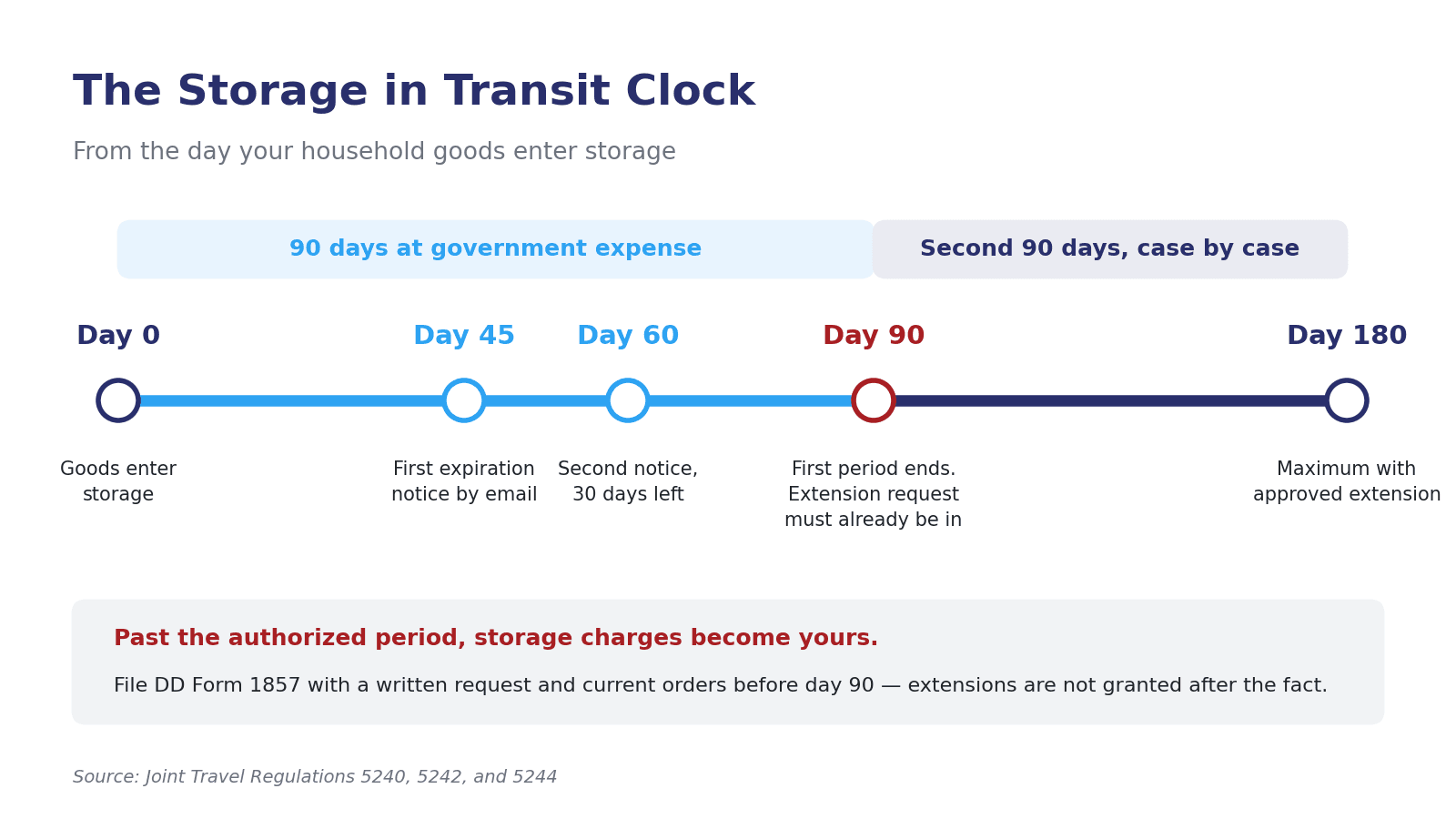
The SIT clock, from the day your goods enter storage to the extended 180-day limit. Source: JTR 5240, 5242, and 5244.
You will get warnings. The Defense Personal Property System, the online system that manages military moves, sends a SIT expiration notice to the email on record at 45 days and again at 30 days before expiration. Make sure the email in that system is one you actually read, especially if you are switching from a duty email to a personal address mid-move.
If you do not respond, the Personal Property Shipping Office will try to reach you, including by contacting your current command. If you still cannot be found or do not answer, the office may convert the shipment to your expense.
Getting a Second 90 Days
When something outside your control keeps you from taking delivery, an additional 90 days can be authorized, for a total of 180. JTR paragraphs 5242 and 5244 list the situations that may qualify, decided case by case.
- Serious illness of the service member
- Serious illness or death of a dependent
- Impending assignment to government or government-controlled quarters, or privatized housing
- Being directed to temporary duty after arriving at the new permanent duty station
- Non-availability of suitable housing
- Awaiting completion of a residence under construction
- Acts of God, such as floods or earthquakes
Two of those are house-hunting reasons in plain clothes. "Non-availability of suitable housing" and "awaiting completion of a residence under construction" are the categories most homebuying families fall into.
There are limits on that generosity. Additional SIT may not be approved when you choose to have a home built while other housing is available, or when you choose to occupy privatized housing too small to hold all of your household goods. Choosing to wait is different from having no option.
The Extension Paperwork
Extensions are not automatic and they are not granted after the fact. Per JTR paragraphs 4242-C and 5244-B, you must:
- Submit a written request
- Submit DD Form 1857, Temporary Commercial Storage at Government Expense
- Include supporting documents, such as a deployment letter or current orders with all amendments
- Get the request in before the first 90-day period expires
You can submit in person, by fax, or by email. The origin or destination Personal Property Shipping Office approves or denies on a case-by-case basis. The responsibility to submit on time is yours, and that is stated repeatedly in the official guidance for a reason.
If you are heading straight into a deployment after reporting, request the extension before you leave. Members can be held responsible for storage costs when an extension was not requested prior to deployment.
SIT Versus Non-Temporary Storage
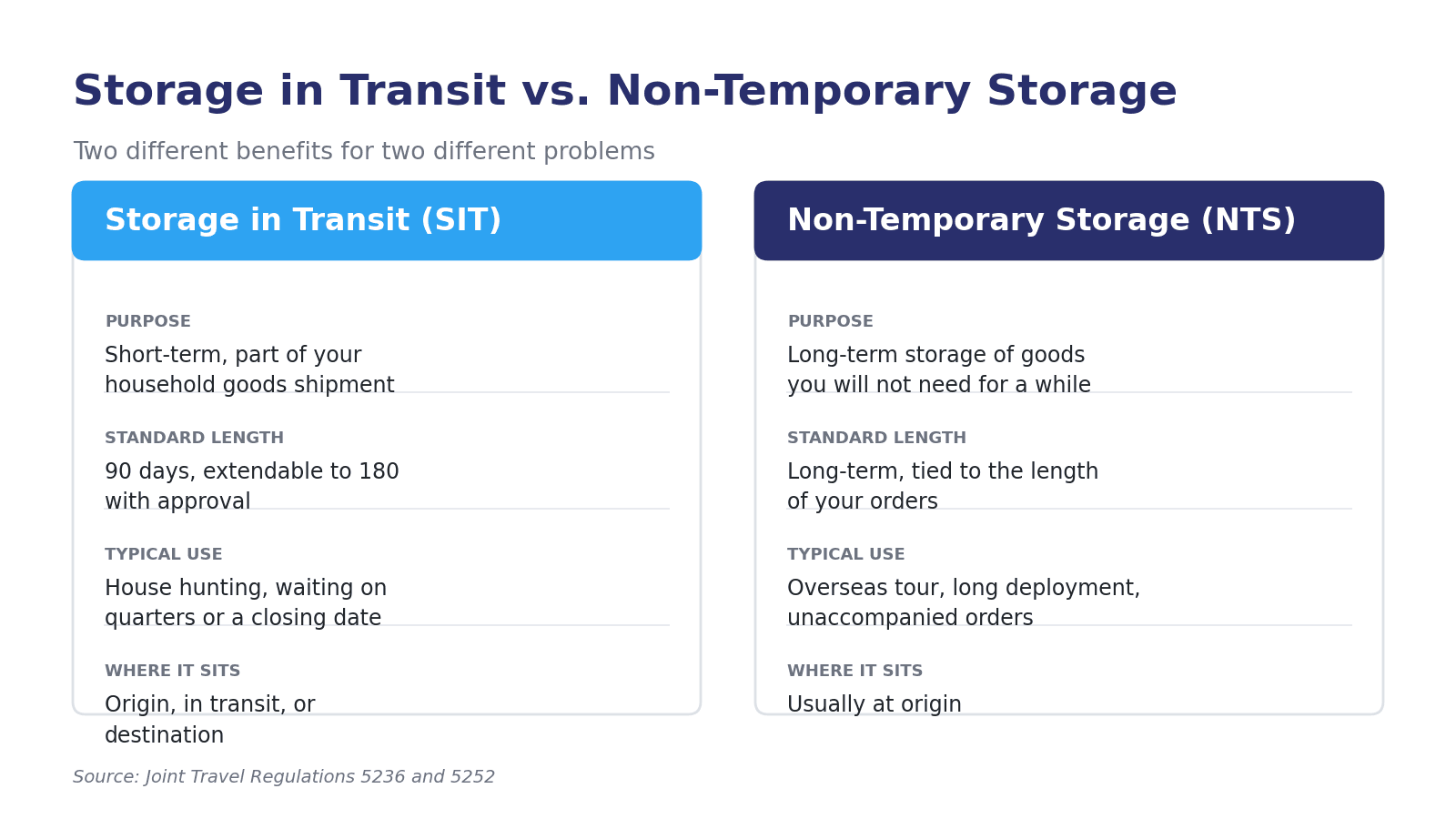
SIT and NTS are different benefits, and knowing which one you need can save you money and stress.
| Storage in Transit (SIT) | Non-Temporary Storage (NTS) | |
|---|---|---|
| Purpose | Short-term, part of the shipment | Long-term storage |
| Standard length | 90 days, extendable to 180 | Long-term, tied to your orders |
| Typical use | House hunting, awaiting quarters | Overseas tour, long deployment |
| Governing rule | JTR 5236 | Requested through your shipping office |