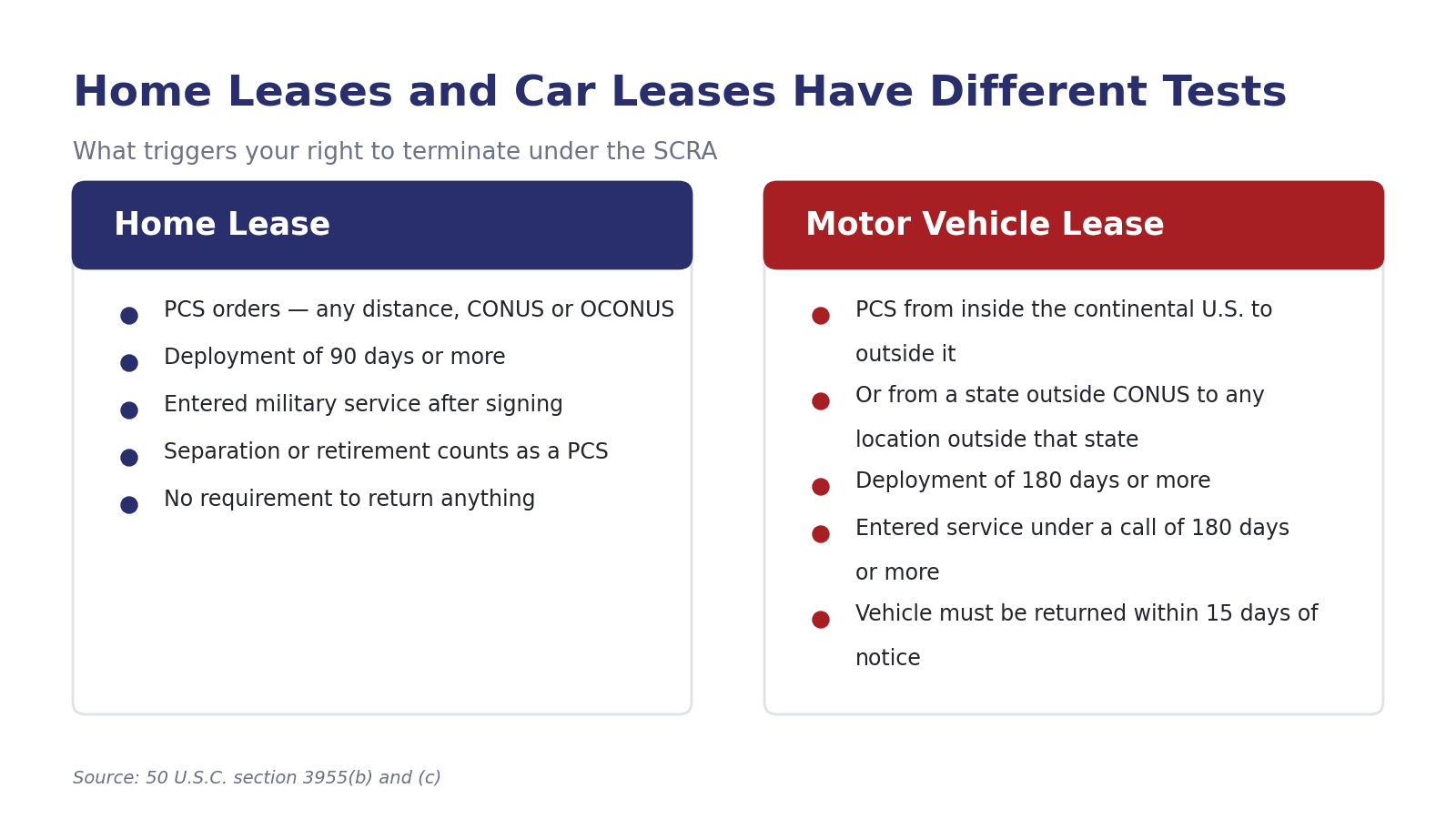
Breaking a lease with military orders is not a favor your landlord grants you. It is a federal right, written into the Servicemembers Civil Relief Act (SCRA), a law that gives service members legal protections while they are on active duty. If you get PCS orders or a long deployment, you can end your lease early, and your landlord cannot charge you an early termination fee for doing it. This guide walks through who qualifies, how to deliver notice the right way, and the exact date your lease actually ends.
The rule lives at 50 U.S.C. section 3955, the part of the SCRA that covers residential and vehicle leases. It is short, it is specific, and knowing the details is what keeps a landlord from talking you out of money you should keep.
Who Qualifies to Terminate a Lease
The law covers a lease of a home, apartment, or similar space that you or your dependents live in. You can terminate it if any one of these is true.
- You signed the lease before you entered military service, and then you entered service.
- You signed the lease while already in the military, and then received PCS orders (Permanent Change of Station, meaning orders to report to a new duty station) or orders to deploy with a unit or as an individual for 90 days or more.
- You signed the lease after receiving those orders, and then received a stop movement order from your service secretary that lasts 30 days or more, or has no set end date, and it keeps you from living there.
Two details in the statute matter more than most people realize. First, "permanent change of station" includes separation and retirement from military service. If you are getting out, that counts. Second, "military orders" is defined broadly. It includes official orders, and also a notification, certification, or verification from your commanding officer about your current or future duty status. If your written orders have not been cut yet, a commander's letter can carry the same weight.
Distance does not matter for a home lease. There is no minimum number of miles between your old place and your new duty station. A PCS across town qualifies just as much as one across the country.
How to Give Notice the Right Way
Termination is not automatic. You have to do two things, and the law spells them out in section 3955(c).
- Deliver written notice that you are terminating the lease.
- Deliver a copy of your military orders along with it.
You may deliver those documents by hand, by a private business carrier, or by U.S. mail in an envelope with return receipt requested. Since January 2021 the statute also allows electronic delivery, including email to an address the landlord designated, posting to a resident portal you have access to, or another electronic method reasonably calculated to make sure the landlord actually receives it.
Whatever method you pick, keep proof. A return receipt, a delivery confirmation, or a saved email with a timestamp is what settles a dispute later. Send the notice to the person or office named in your lease, not just to whoever answers the leasing office phone.
When Your Lease Actually Ends
This is where families most often guess wrong. Your lease does not end 30 days after you hand over the notice.
For a home lease that charges rent monthly, termination takes effect 30 days after the first date the next rent payment is due after your notice is delivered. Work the calendar in that order.
Say rent is due on the first of the month and you deliver notice on August 20. The next rent due date is September 1. Thirty days after that is October 1, and that is when the lease ends. You owe September rent, and you should plan to be out by the first of October.
For any other covered home lease that does not bill monthly, termination is effective on the last day of the month following the month in which you delivered the notice. For a lease you are ending because of a stop movement order, termination is effective on the date you meet the notice requirements.
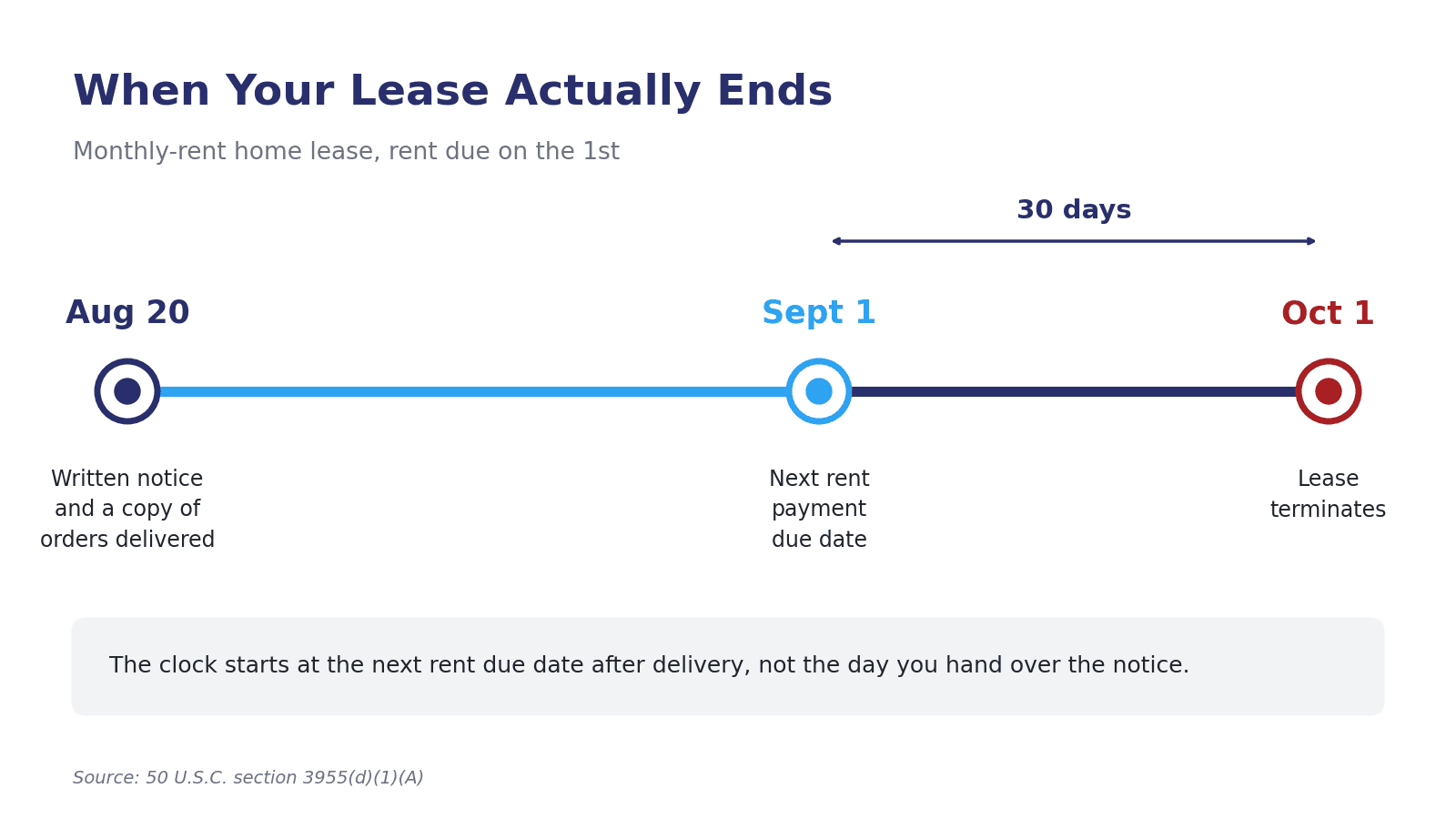
How the SCRA termination clock works for a monthly-rent lease. Source: 50 U.S.C. section 3955(d).
Because the clock starts at the next rent due date rather than the notice date, delivering your notice a few days earlier can save you a full month of rent. If your orders are in hand, do not sit on them.
What You Owe, and What You Do Not
Once the lease terminates properly, the law is clear about the money.
- Your landlord may not charge an early termination fee. That is the whole point of the protection.
- Rent for the period before the termination date is prorated and paid.
- Rent or lease amounts you paid in advance for time after the termination date must be refunded to you within 30 days of the effective termination date.
- You still owe legitimate obligations under the lease that are due and unpaid, including taxes, summonses, and reasonable charges for excess wear.
Your security deposit is treated seriously. Section 3955(h) makes it a federal misdemeanor for someone to knowingly hold your security deposit or personal property in order to press a claim for rent that accrues after your lease ended, or to interfere with you removing your belongings. Ordinary deductions for actual damage still follow your state's landlord-tenant law, but a landlord cannot hold your deposit hostage over rent for months you no longer owe.
If you signed the lease jointly, your termination also ends any obligation your dependent has under that lease. A spouse listed on the lease is not left holding it.
One more protection worth knowing: the SCRA also allows a spouse or dependent to terminate the lease within one year of the service member's death, if the member dies in military service. A similar one-year window applies after a catastrophic injury or illness incurred during service.
Working through a PCS budget and not sure what to prioritize? Our guide to PCS entitlements and benefits covers what the military pays for, and PCS travel pay in 2026 breaks down mileage and per diem.