

A VA (Department of Veterans Affairs) home loan lets you buy with no down payment, but it does not make closing free. You will still owe closing costs, the collection of fees a lender and third parties charge to finish your loan. The good news for military buyers is that the VA loan comes with rules that limit what a lender can charge you and let the seller pick up a large share of the bill. This guide breaks down VA loan closing costs in plain language, shows who can pay them, and gives you simple ways to keep more cash in your pocket on move-in day.
What Are VA Loan Closing Costs?
Closing costs are the fees due when your home purchase becomes final. On a VA loan they usually run about 3 to 5 percent of the loan amount, though the exact figure depends on your price, your location, and your lender. On a $300,000 loan, that is roughly $9,000 to $15,000 in fees, separate from any down payment (which the VA loan does not require).
These costs fall into three buckets: lender fees for making the loan, third-party fees for services like the appraisal and title work, and prepaid items such as property taxes and homeowners insurance that fund your escrow account. New to how the benefit works? Start with our guide to how a $0 down VA loan works.
Closing Costs You Can Expect to Pay
Most VA buyers see a similar list of charges. The table below shows the common ones and who usually provides the service.
| Closing cost | What it covers |
|---|---|
| VA funding fee | A one-time fee paid to the VA (more below) |
| Loan origination charge | The lender's fee to process and underwrite the loan |
| VA appraisal fee | The VA-assigned appraisal of the home's value and condition |
| Title insurance and search | Confirms clear ownership and protects the lender |
| Recording and transfer fees | Government fees to record the sale |
| Prepaid taxes and insurance | Funds your escrow account for property taxes and hazard insurance |
| Credit report and discount points | Your credit pull, plus any optional points to buy down the rate |
The VA appraisal is its own step with its own rules. Learn what it checks and how long it takes in our guide to the VA loan appraisal.
The VA Funding Fee
The largest single closing cost for many buyers is the VA funding fee. This one-time fee helps keep the loan program running so it can stay no-down-payment for future service members. The rate depends on your down payment and whether it is your first VA loan.
| Down payment | First use | After first use |
|---|---|---|
| Less than 5% | 2.15% | 3.3% |
| 5% or more | 1.5% | 1.5% |
| 10% or more | 1.25% | 1.25% |
Source: VA.gov funding fee and closing costs, rates effective April 7, 2023.
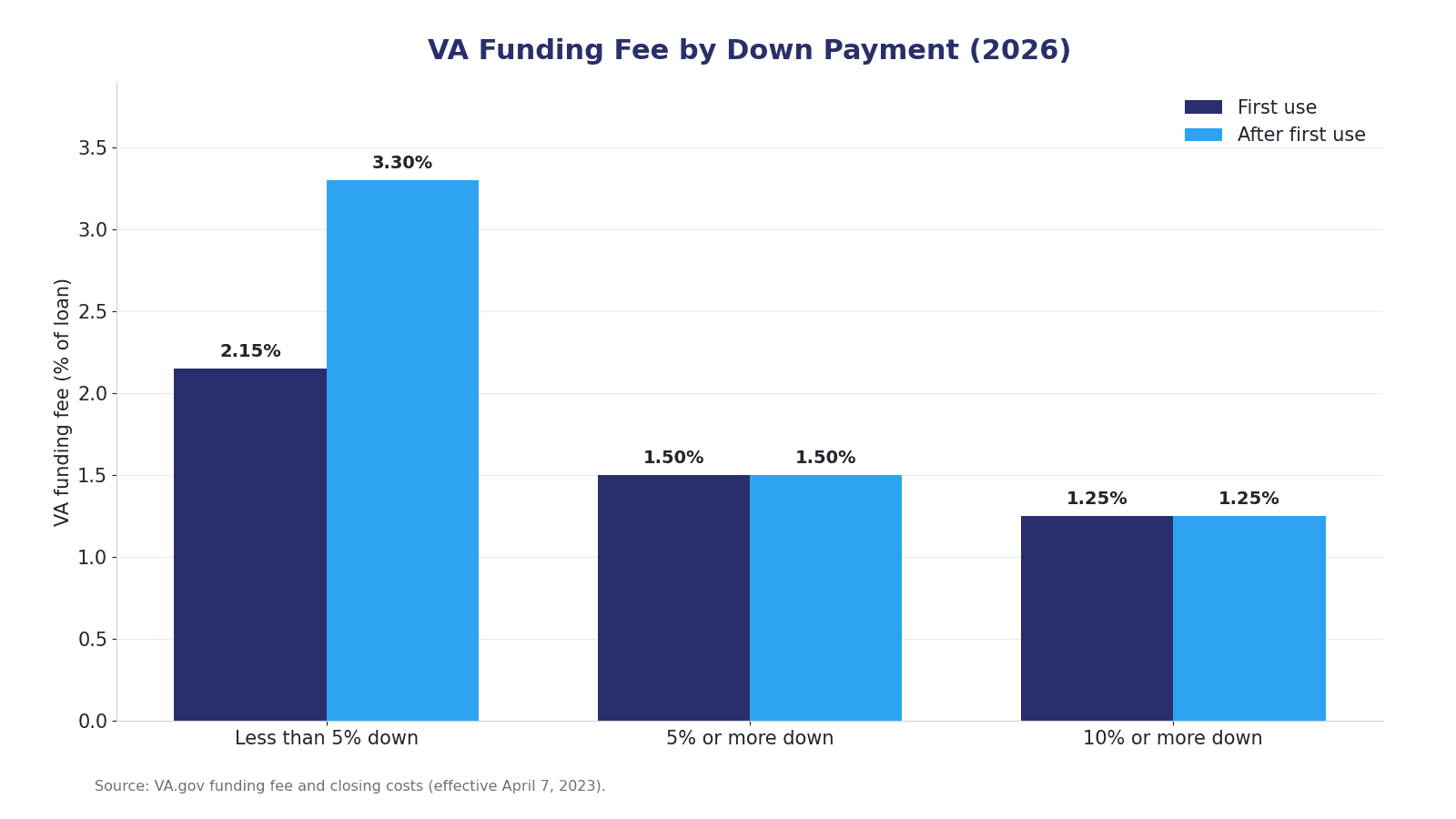
VA funding fee by down payment. A larger down payment lowers the fee. Source: VA.gov.
Two things make the funding fee easier to handle. First, you can roll it into your loan instead of paying it in cash at closing. Second, many buyers do not pay it at all. According to VA.gov, you are exempt if you receive VA compensation for a service-connected disability, are eligible to receive it but take retirement or active-duty pay instead, are a surviving spouse receiving Dependency and Indemnity Compensation, or are an active-duty member with a Purple Heart on record before closing. For the full picture, see our complete guide to the VA funding fee.
Planning Your Next Move?
Connect with Veteran & Military Spouse Real Estate Agents and VA Loan Experts You Can Trust.
Fees the VA Will Not Let You Pay
The VA protects buyers by capping and blocking certain lender charges. The lender's total charge for originating the loan is limited to a flat 1 percent of the loan amount, which must cover the lender's overhead. On top of that, the VA names certain "non-allowable" fees the veteran is not allowed to pay, such as attorney fees charged by the lender, application or processing fees, and any prepayment penalty, as explained by Veterans United. If those fees appear, the seller, the lender, or the real estate agent must cover them, not you.
Who Can Pay Your VA Loan Closing Costs
You do not have to cover the whole bill yourself. The VA gives you two separate ways to shift costs to the seller.
- Regular closing costs: A seller or builder can pay some or all of your standard closing costs, and the VA sets no limit on that amount.
- Seller concessions: A seller can also add "concessions" worth up to 4 percent of the home's VA-appraised value. Concessions are extras beyond normal closing costs, such as paying your funding fee, covering prepaid taxes and insurance, or paying off a buyer's debt.
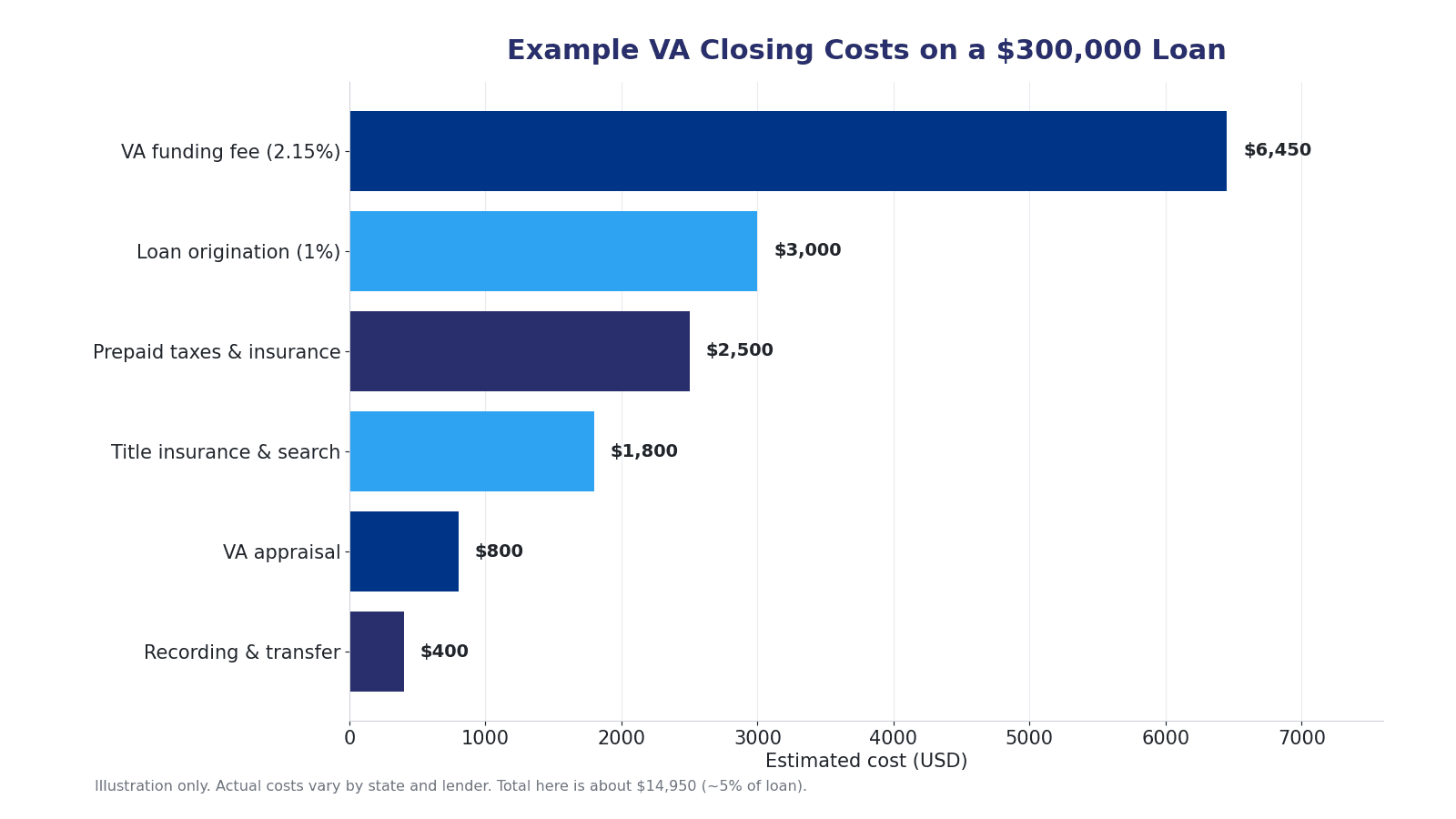
An example of how VA closing costs can add up on a $300,000 loan. Your figures will differ by state and lender.
Sellers are often willing to help, especially in a slower market. A VeteranPCS agent who knows VA loans can write these credits into your offer so you keep more cash for the move.
How to Lower Your VA Loan Closing Costs
A few smart moves can shrink your bill:
- Ask the seller to cover closing costs as part of your offer, and use concessions to pay the funding fee.
- Compare Loan Estimates from more than one VA-experienced lender. Fees vary, and the origination charge is negotiable.
- Roll the funding fee into the loan if paying cash at closing would stretch you thin.
- Check your funding fee exemption. If you have a service-connected disability rating, you may owe no funding fee at all.
- Time your rate. Buying discount points only pays off if you keep the loan long enough to earn the savings back.
Free First-Time Homebuyer Guide
Make your move less stressful with our step-by-step first-time homebuyer guide.
We respect your privacy. Unsubscribe anytime.Your lender and agent work as a team on this. See who else belongs on that team in our guide to the VA loan home-buying team.
Frequently Asked Questions
Can I finance all my closing costs into a VA loan? No. On a purchase loan, the VA lets you roll in only the funding fee. All other closing costs must be paid at closing, though the seller can cover them.
How much are VA closing costs on a $300,000 home? Plan for roughly 3 to 5 percent of the loan, or about $9,000 to $15,000, before any seller help. The funding fee is often the biggest piece.
Do I pay closing costs if I have a VA disability rating? You still pay standard closing costs, but a service-connected disability rating usually makes you exempt from the funding fee, which can save thousands.
Who pays the real estate agent? Commission is negotiated in your contract. On a VA loan, this is one more cost a seller can agree to cover. Learn more about seller concessions and closing costs.
The Bottom Line
VA loan closing costs are real, but the program is built to keep them manageable. The VA caps lender charges, blocks certain fees, lets you finance the funding fee, and allows sellers to pay a large share of the bill. Knowing these rules before you write an offer is how military buyers hold onto their savings.
Connect with a VeteranPCS lender to get a clear Loan Estimate, or find a military-experienced agent who can negotiate seller-paid costs into your offer.
Know someone starting a home search before their next PCS? Share this guide with your military network so they can plan for closing day.
This content is for informational purposes. Consult a professional for personal financial decisions.