For most of a military career, the hunt for a new home starts with one easy question: where is the base? Orders pick the city, and the family builds daily life around the installation. Retirement takes that starting point away. For many families, this last move, often called the final PCS (Permanent Change of Station), is the first time in 20 years or more that no one else picks the map, and deciding where to live after military retirement is up to you.
That freedom raises a harder question. If the base is no longer the center of your life, what should be? This guide walks through a simple way to make that choice, using Orlando, Florida, as a working example. Orlando has strong veteran resources and a defense community inside a much larger civilian region. Whether it fits depends on what your household needs most, and the same steps work for any city.
The framework comes from Ted Moseley, a 20-year U.S. Navy veteran, Orlando REALTOR with Real Broker, LLC, and VeteranPCS agent. In his guide, Is Orlando a Good Place to Live After Military Retirement? A Veteran's Local Guide, Ted applies these questions to Central Florida's job centers, healthcare locations, housing costs, and everyday roads. His central idea is simple: decide what you want the next chapter to look like, then choose the place that supports it.
Where to Live After Military Retirement: Why the Choice Feels Different
On active duty, the installation was the fixed point on the map. After retirement, several things compete for that spot:
- A second career, or no career at all
- A spouse's job, which may now carry equal weight
- Where each person in the house gets regular healthcare
- Family you want to live closer to
- The full monthly cost of a home
- How you want a normal week to feel
There is no single right answer. The goal is to rank these for your household before you look at houses.
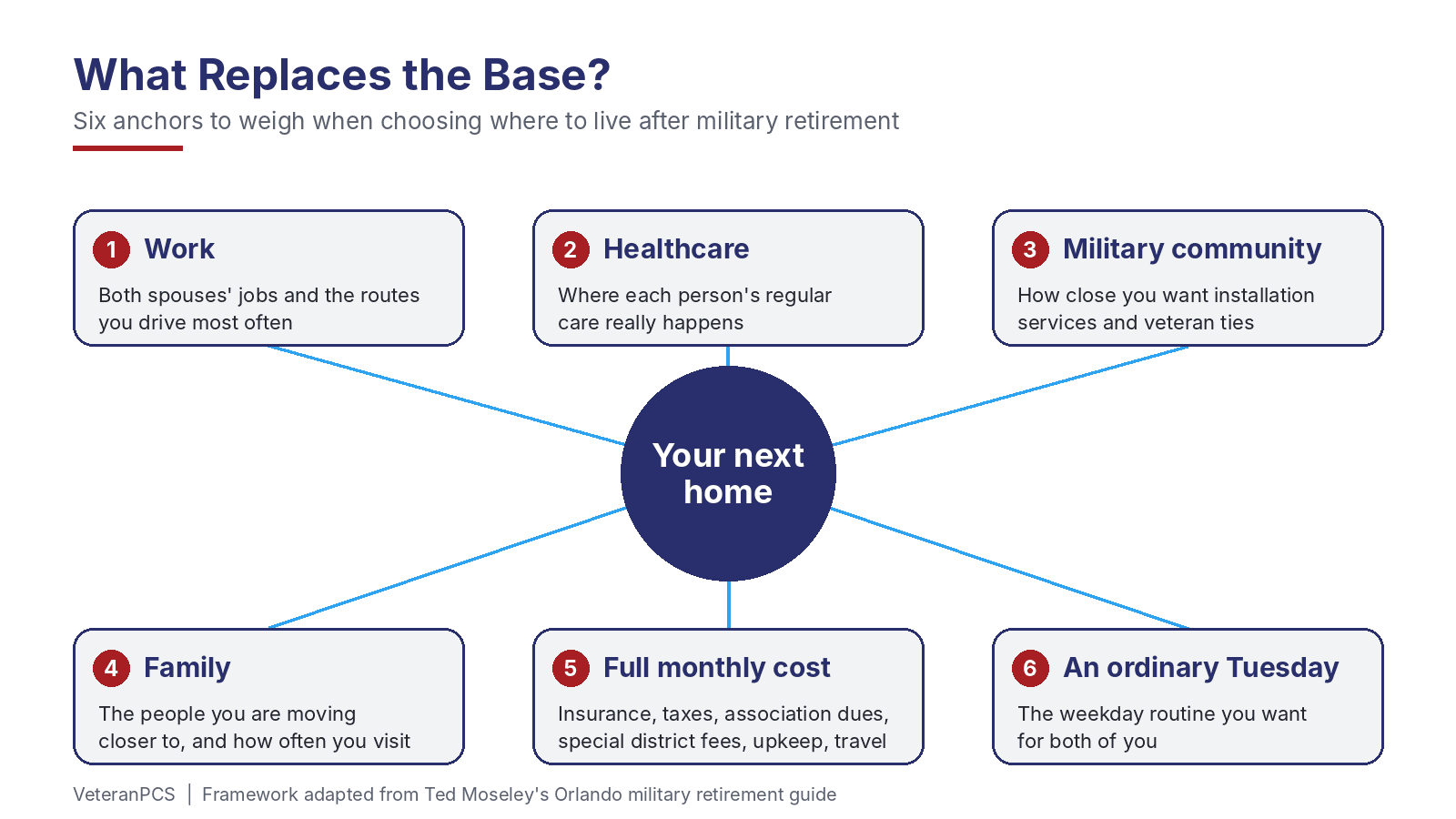
Six anchors that can take the base's place at the center of your life after retirement.
Step 1: Start With Work, Yours and Your Spouse's
If either of you plans to work, the job location is a strong starting point, but only one. Two jobs may sit on opposite sides of a metro area.
In Orlando, different job centers can point you toward very different home searches:
- Central Florida Research Park, next to the University of Central Florida (UCF) on the east side, is home to Naval Support Activity (NSA) Orlando and many defense and simulation employers. Our guide to moving to Orlando for a Research Park or defense job compares the communities near it.
- Lake Nona, in southeast Orlando, is where the U.S. Department of Veterans Affairs (VA) runs the Orlando VA Medical Center.
- The Interstate 4 (I-4) corridor runs through the region, with job centers such as Lake Mary to the north.
Ask a few plain questions. Is the job in the office every day, or hybrid? Is the offer firm? If one job is certain and the other is not, how much should the unknown job shape the search?
Then list the places each of you will drive to most often in a normal week, ranked by how often you go. Both spouses' routes matter more than any single address.
Step 2: Map Healthcare Before You Map Houses
Healthcare is easy to overlook during a house hunt, yet for many retirees it shapes daily life more than any job. Start by confirming which care each person will actually use:
- VA health care. Eligibility depends on your service and discharge, and enrollment is a separate step. According to VA.gov's eligibility page, each enrolled veteran is placed in one of eight priority groups, which can affect how soon you are enrolled and what you pay.
- TRICARE. TRICARE is the military health care program. TRICARE's retiring page explains that retiring from active duty is a Qualifying Life Event that changes your plan options. It asks retirees to enroll within 90 days of their retirement date to avoid a break in coverage, and it explains what to do if that window passes. TRICARE Prime is only offered in Prime Service Areas, so your new address can affect your plan choices. Check the page for the rules that fit your situation.
- Your spouse and family. A spouse may have separate doctors or a civilian network. Their appointments count just as much as yours.
In the Orlando example, the Orlando VA Medical Center sits at 13800 Veterans Way in Lake Nona. It offers primary care, specialty care, and an emergency department open around the clock. The Orlando VA system also runs clinics across the region, including Clermont, Kissimmee, Deltona, Tavares, Viera, Palm Bay, Port Orange, and Daytona Beach.
So you do not need to live next to the main hospital. Find out where your regular appointments will really happen. Routine visits may be at a nearby clinic, while specialty visits may be at the medical center. Map both, plus your spouse's providers.
Not sure which neighborhoods line up with your work and care? Ask Ted Moseley, a Navy veteran and VeteranPCS agent in Orlando, to help you compare areas.
Step 3: Decide How Much Military Community You Want
Some retirees want the commissary, the exchange, and active duty friends close by. Others prefer a civilian daily life with veteran ties. Both are fine. Just know which one you are.
Orlando is a good test of this question, because its military presence looks different from a typical base town. The Navy's NSA Orlando installation guide describes a 40-acre facility inside Central Florida Research Park. It is home to the Naval Air Warfare Center Training Systems Division and the Army's Program Executive Office for Simulation, Training and Instrumentation. The same guide notes very limited support services on the installation. There is no commissary in Orlando. The nearest full-service commissary is at Patrick Space Force Base, about 54 miles away, and the Navy Exchange is near Orlando International Airport.
In other words, Orlando's military presence centers on training and simulation, not a large operational base that organizes the region. Some retirees want exactly that balance. Others will look closer to a larger installation.
If military services matter to you, list the ones you would really use and time the drive to each. For veteran support, the Florida Department of Veterans' Affairs offers free claims help through state service officers, and county veteran service offices offer free counseling too.
Step 4: Build a Whole-Household Budget
The Florida Department of Revenue confirms that Florida does not impose a personal income tax. That matters, but it is only one line in your budget.
Use current quotes for the actual homes you are considering:
| Cost item | Where to get the real number | What to watch for |
|---|---|---|
| Homeowners insurance | Quotes from insurers or an agent, for that address | Roof age, construction, and wind features can change the price |
| Property taxes | The county property appraiser and tax collector | Taxes can change after a sale, so do not rely on the seller's bill |
| Homeowners association (HOA) dues | The association's documents | Ask what the dues cover and about planned increases |
| CDD assessments | The sales contract and the county tax bill | Some newer Florida communities add these on top of county taxes |
| Maintenance | A home inspection and the home's age | Plan for roof, heating and air conditioning, and storm-related upkeep |
| Transportation | Your weekly drive list from Step 1 | Several major Orlando roads are toll roads |
A few Florida details are worth knowing:
- Insurance. The Florida Office of Insurance Regulation explains that a wind mitigation inspection documents a home's storm-resistant features and may help you qualify for premium discounts. The Florida Department of Financial Services also publishes a homeowners insurance toolkit for shoppers. Our hurricane prep guide for military families in Florida covers storm planning.
- CDDs. A Community Development District (CDD) is a special district that can fund roads, utilities, and amenities in some newer communities. Under Florida Statute 190.048, the first sale contract in a district must disclose that its taxes and assessments are in addition to county and other local taxes.
- Exemptions. Florida's homestead exemption and several veteran exemptions are real, but none are automatic. The Florida Department of Revenue's property tax guide for military and veterans shows that most veteran benefits depend on factors such as a disability rating, and you apply through the county property appraiser. Do not build your budget on an exemption until you know you qualify. Our Florida veteran property tax exemptions guide explains each one.