California is a big state with a small Army footprint. If you have orders here, the army bases in California are easier to keep straight than you might expect, because there are only six of them and no two do the same job. One trains whole brigades for combat in the desert. One teaches foreign languages on the coast. The rest are Reserve training land and logistics sites.
This guide walks through each installation, then spends real time on the part that shapes your whole tour: what it costs to live nearby. PCS stands for Permanent Change of Station, the military's term for a move to a new duty station.
Every Army Installation in California, at a Glance
The Army's own benefits site lists four common Army resources in the state: Fort Irwin, the Presidio of Monterey, Fort Hunter Liggett, and the Army Reserve at Camp Parks. You can see that list on the MyArmyBenefits California resource page. Two more Army-run sites round out the picture: Sierra Army Depot in the far northeast and Military Ocean Terminal Concord on San Francisco Bay.
| Installation | Where it is | What it does |
|---|---|---|
| Fort Irwin (National Training Center) | High Mojave Desert, about 39 miles northeast of Barstow | Large-scale combat training rotations |
| Presidio of Monterey | City of Monterey, central coast | Home of the Defense Language Institute Foreign Language Center |
| Fort Hunter Liggett | San Antonio Valley, southern Monterey County | The Army's largest Reserve installation and training area |
| Parks Reserve Forces Training Area (Camp Parks) | Dublin, east San Francisco Bay | Army Reserve garrison and West Coast training platform |
| Sierra Army Depot | Herlong, far northeastern California | Long-term storage, sustainment and repair of Army equipment |
| Military Ocean Terminal Concord | Contra Costa County, San Francisco Bay | Army seaport for ammunition and general cargo |
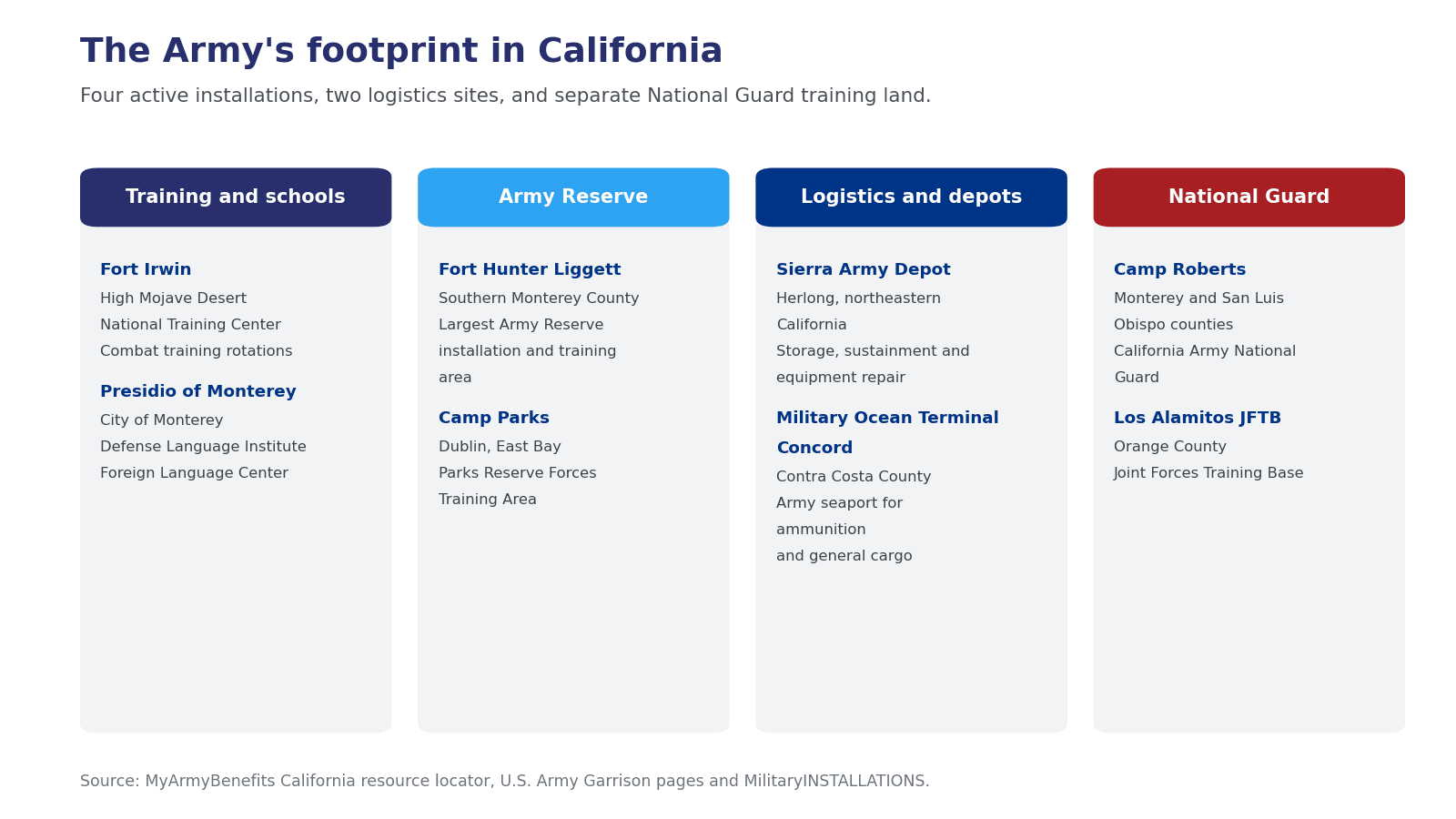
The Army's California footprint, grouped by mission. Source: MyArmyBenefits California resource page and the individual garrison sites.
Only two of these are posts a family typically PCSes to: Fort Irwin and the Presidio of Monterey. The rest are Reserve sites or logistics operations with few permanent party billets.
What Each Post Does
Fort Irwin and the National Training Center
Fort Irwin sits in the High Mojave Desert about 39 miles northeast of Barstow, roughly midway between Las Vegas and San Bernardino. It is the Army's National Training Center, and it runs 10 large training rotations a year. Between 5,000 and 6,000 Soldiers from other installations rotate through each month, on top of a daily population of about 23,390 people, per MilitaryINSTALLATIONS.
The permanent party is smaller than that number suggests: about 4,601 active duty, 6,594 family members and 4,150 civilian employees. The 11th Armored Cavalry Regiment, the Blackhorse Regiment, lives here and plays the opposing force for every rotation. If you are assigned to the 11th ACR or to Operations Group, expect several days a month in the field.
Fort Irwin is remote. There are no gas stations between Barstow and the front gate, and Big Bear is about two hours away. We cover arrival details in our PCS to Fort Irwin guide.
Presidio of Monterey
The Presidio sits in the city of Monterey, about 120 miles south of San Francisco. Its main tenant is the Defense Language Institute Foreign Language Center, or DLIFLC, which teaches more than a dozen languages and is one of the largest language schools in the world.
The student body is the story here. The garrison supports about 9,692 active-duty students from all five services plus roughly 1,590 faculty and civilian staff, while only about 230 service members are permanently assigned. Most military housing is not on the Presidio itself. It sits about 8 miles away at the Ord Military Community, on part of what used to be Fort Ord, and at The Parks at Monterey Bay. Our PCS to Presidio of Monterey guide covers the arrival timeline, including the four-week restriction for Soldiers coming straight from Basic Combat Training.
Fort Hunter Liggett
Fort Hunter Liggett is in the San Antonio Valley in southern Monterey County, inland from the coast. It is the largest Army Reserve installation, with more than 160,000 acres of year-round training land used by joint, multi-component and interagency units. Permanent party is small. Most people here are units training for a few weeks at a time.
Parks Reserve Forces Training Area (Camp Parks)
Camp Parks is in Dublin, in the east San Francisco Bay. Officially it is Parks Reserve Forces Training Area, and it is a sub-installation of Fort Hunter Liggett, about 156 miles to the south. It hosts more than 30 tenant units, including the 91st Training Division. The site started in 1943 as a Navy staging base and the Army took it over in 1980.
Sierra Army Depot
Sierra Army Depot is at Herlong in far northeastern California. It is one of 26 sites in the Army's Organic Industrial Base and falls under U.S. Army Tank-automotive and Armaments Command. The work is long-term storage, equipment sustainment, and repair of Army fuel and water systems, as the TACOM depot page lays out. The workforce here is mostly civilian.
Military Ocean Terminal Concord
Military Ocean Terminal Concord, usually called MOTCO, is on San Francisco Bay in Contra Costa County. It is the Army's California seaport for ammunition and general cargo, and one of only two Army ammunition terminals in the country. The 834th Transportation Battalion runs three piers and an Army-owned rail system there.
For the other branches in the state, see our overview of what military bases are in California and our companion post on the Air Force and Space Force side of California.
National Guard Sites Are Not Active-Duty Posts
Two more names come up often, and both are California Army National Guard sites rather than active-duty Army posts.
Camp Roberts spans 42,361 acres across Monterey and San Luis Obispo counties. It is the largest Army Guard training site in the state and handles armor, artillery, aviation and live-fire training.