

Buying a home with a power of attorney is how many military families close on time when orders, a deployment, or a PCS keep the service member far from the closing table. A power of attorney, or POA, is a legal document that lets someone you trust, usually your spouse, sign paperwork on your behalf. Used correctly, it means a deployment does not have to delay your move or cost you the house. This guide covers how a POA works in a home purchase, what the VA (Department of Veterans Affairs) and lenders require, and how to keep your closing on track from anywhere in the world.
What a Power of Attorney Does in a Home Purchase
A POA names a person, called your attorney-in-fact, who can act for you. In a home purchase that person can sign the offer, loan documents, and closing paperwork while you are deployed or still at your old duty station. For most military buyers, the attorney-in-fact is a spouse who is already at the new base and can attend closing in person.
There are two broad types, and the difference matters for a real estate deal.
| Type of POA | What it covers | Best for |
|---|---|---|
| Specific (limited) | One defined task, such as buying a named property | Most home purchases and VA loans |
| General | Broad authority over many affairs | Wider needs, but often not enough for lenders on its own |
Lenders and title companies usually prefer a specific POA for a home purchase because it spells out exactly what the signer is allowed to do. If you are also buying without seeing the home in person, pair this with our guide to buying a home sight unseen during a PCS move.
What the VA and Lenders Require
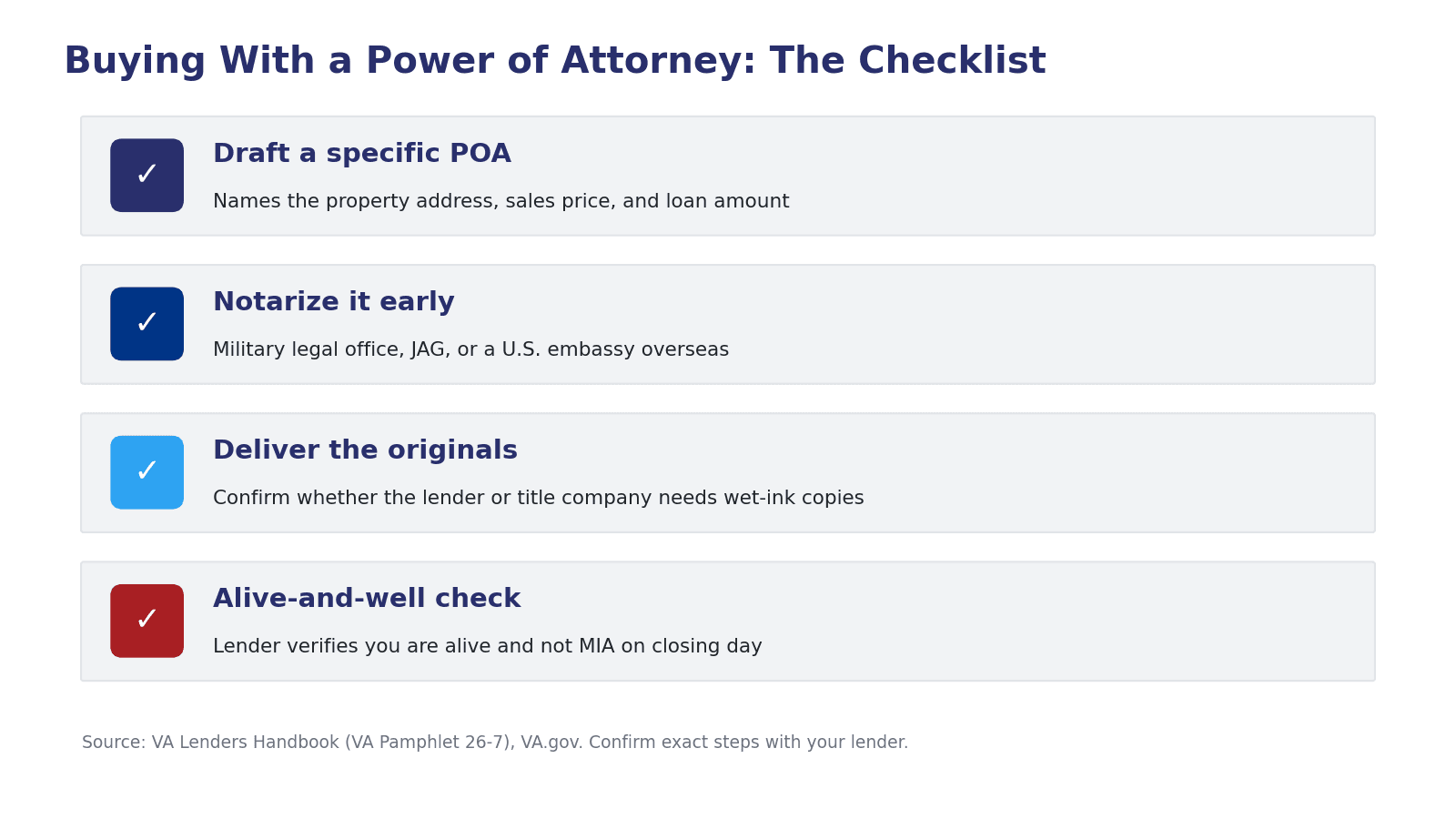
The VA allows a loan to close using a power of attorney, but it sets clear guardrails. Based on VA lender guidance summarized in the VA Lenders Handbook, the POA generally must be specific to the transaction and name key details like the property address, the sales price, and the loan amount. You also have to give written consent to the loan terms.
There is one more military-specific step: the alive-and-well statement. Because a POA is being used, the lender must verify on the day of closing that the service member is alive and, if on active duty, not in a missing-in-action status. This is often a quick verbal or written confirmation arranged in advance, but it is required, so build it into your plan. Ask your lender exactly how they handle it before you set a closing date. When you are ready, connect with a VeteranPCS lender who has closed VA loans with a POA before.
- Use a specific POA that names the property, price, and loan amount.
- Provide written consent to the loan terms.
- Plan for the alive-and-well verification on closing day.
- Ask whether the lender or title company needs wet-ink original documents.
Planning Your Next Move?
Connect with Veteran & Military Spouse Real Estate Agents and VA Loan Experts You Can Trust.
A specific POA plus the closing-day alive-and-well check keeps a deployed purchase moving. Source: VA Lenders Handbook, VA.gov.
Getting a POA Signed Overseas
If you are downrange, you can still get a valid POA. Military legal assistance offices provide notary services at no cost, and a Judge Advocate General, or JAG, attorney can help you prepare the document. U.S. embassies and consulates also offer notary services abroad. Because rules on notarization and mailing originals vary by lender and by state, confirm the requirements early so an original document is not stuck in transit on closing day.
Give yourself extra time for mail and time zones. A POA that is signed, notarized, and in the right hands a week early is far better than a perfect document that arrives a day late.
Tips to Keep Your Closing on Track
Start the POA conversation the moment you decide to buy, not the week of closing. Tell your agent, lender, and the title company up front that a POA will be used, since each one may have its own form or wording. Line up your support team early using our guide to the VA loan home-buying team, and if this move is overseas, review our guide to an overseas PCS so the housing piece fits the bigger picture.
Frequently Asked Questions
Can my spouse sign for me at closing if I am deployed? Yes. With a valid power of attorney naming your spouse as attorney-in-fact, they can sign the purchase and loan documents on your behalf.
Free First-Time Homebuyer Guide
Make your move less stressful with our step-by-step first-time homebuyer guide.
We respect your privacy. Unsubscribe anytime.Does the VA allow a power of attorney on a VA loan? Yes, but the POA generally must be specific to the transaction, and the lender must verify you are alive and well on closing day.
What is an alive-and-well statement? It is the lender's day-of-closing confirmation that the service member is alive and, if on active duty, not missing in action. It is required whenever a POA is used.
Where can I get a POA notarized overseas? Military legal assistance offices, JAG attorneys, and U.S. embassies or consulates all provide notary services.
The Bottom Line
Buying a home with a power of attorney lets a deployment or a PCS proceed without putting your move on hold. Use a specific POA that names the deal, plan for the alive-and-well check, get the document notarized early, and keep your agent, lender, and title company in the loop. With the paperwork lined up, your family can close and settle in even when duty keeps you away.
Find a military-experienced agent who has handled POA closings, or connect with a VeteranPCS lender to start your pre-approval.
Know a service member deploying before a move? Share this guide so their closing stays on track.
This content is for informational purposes. Consult a professional for personal financial decisions.