
The VA loan occupancy requirements are simple on paper and easy to trip over in real life, especially when you have orders in hand. The VA (Department of Veterans Affairs) backs your loan on one core promise: the home is where you plan to live, not a rental you bought from a distance. For military families, the hard part is that a Permanent Change of Station, or PCS, can move you before the ink is dry. This guide explains what the occupancy rule really says, who can meet it while you are deployed, and how PCS orders let you rent the home down the road without breaking the rules.
What the VA Occupancy Rule Actually Says
To use a VA loan, you sign a certification that you intend to occupy the home as your primary residence. Occupancy generally has to happen within a reasonable time, which the VA treats as 60 days after closing. As VA.gov explains, the benefit is meant for a home you will live in, not an investment property you never move into.
Two words carry the weight here: intent and primary. You are certifying that you honestly plan to make this your main home. A vacation house or a property you buy purely to rent out does not qualify for a standard VA purchase loan. If you are still learning how the benefit works, start with our guide to how a zero-down VA loan works and the wider benefits of a VA loan.
When You Are Deployed or on Active Duty
Military life rarely lines up with a 60-day window, so the VA built in room for how service members actually live. The rule is about intent, and the VA recognizes that duty can keep you away from the door.
If you cannot move in because of active-duty service, your spouse can satisfy the occupancy requirement for you. A deployed service member, single or married, is treated as being in a temporary duty status and can still provide a valid intent-to-occupy certification. In some cases a dependent child can occupy the home, with the certification made by the veteran's attorney-in-fact or the child's legal guardian. The unmarried, active-duty buyer who cannot occupy right away generally has up to 12 months, rather than 60 days, to move in.
| Situation | Who can satisfy occupancy |
|---|---|
| You move in yourself | You, within about 60 days of closing |
| You are deployed | You (temporary duty status) or your spouse |
| You are on active duty elsewhere | Your spouse on your behalf |
| Unmarried and on active duty | You, generally within 12 months |
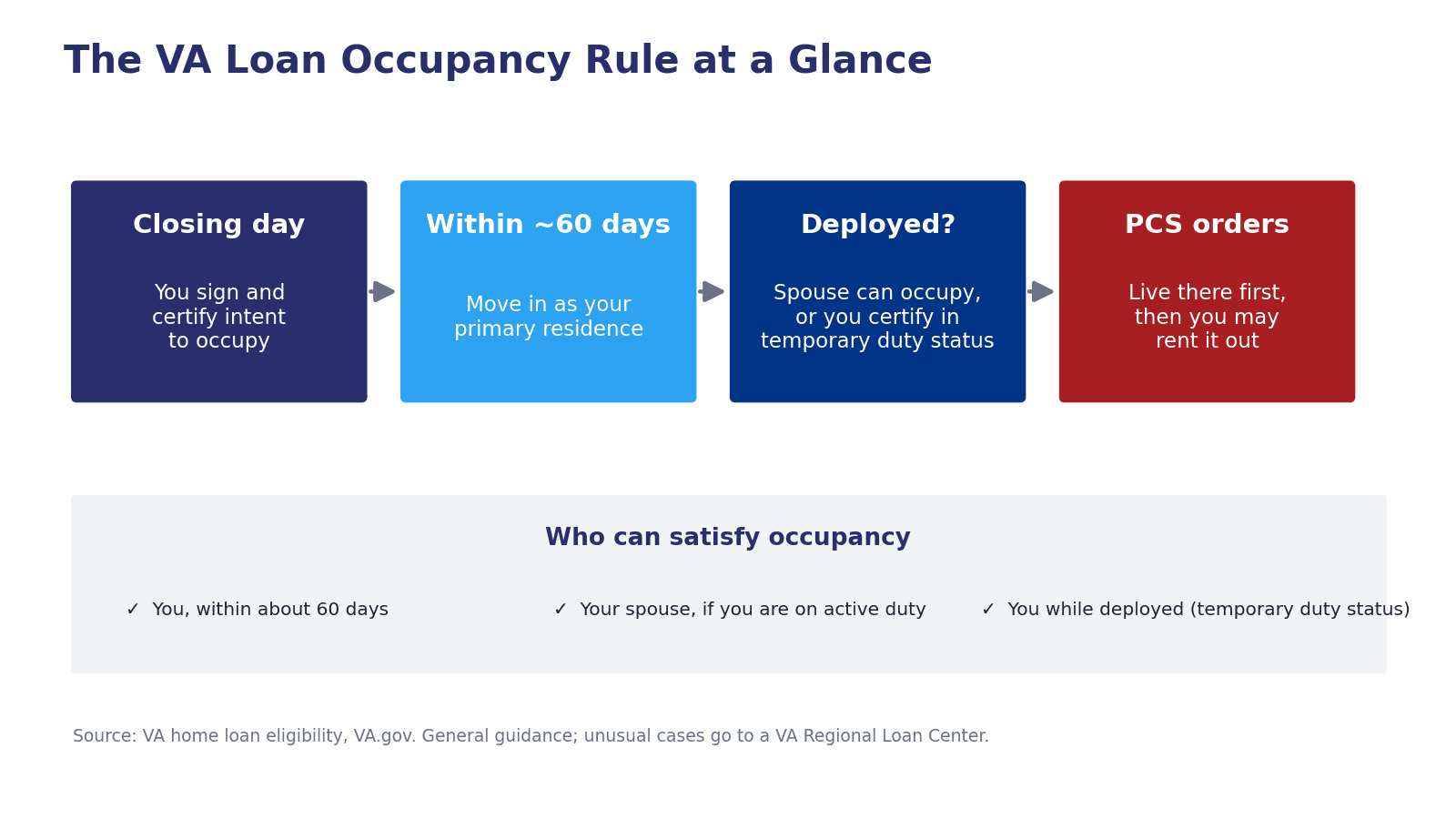
The VA occupancy rule centers on intent to occupy, with built-in flexibility for active-duty and deployed buyers. Source: VA home loan eligibility, VA.gov.
Planning Your Next Move?
Connect with Veteran & Military Spouse Real Estate Agents and VA Loan Experts You Can Trust.
If your situation is unusual, the VA's own guidance says to contact a VA Regional Loan Center to talk it through. A lender who closes VA loans every week can flag the right paperwork before it becomes a problem. When you are ready, connect with a VeteranPCS lender to map your timeline.
What Happens When You Get PCS Orders
Here is the part that matters most for a military career: the occupancy rule looks at your intent when you buy, not forever. Once you have lived in the home and then receive PCS orders, you are allowed to move and rent the property out. The orders are your proof that the move is service-driven, not a sign you never meant to live there.
Two paths open up at that point. You can keep the home and rent it, or you can sell. If you keep it and want to buy again at your next base, you may be able to use your remaining, or second-tier, VA entitlement to hold two VA loans at once. We walk through that in can you use the VA loan more than once. To decide whether keeping it even makes sense, run the numbers in rent or sell your home when you PCS.
What the Rule Is Not Meant For
The occupancy requirement blocks pure investment purchases, but it does not stop smart, service-connected strategies. You can buy a two-to-four-unit property, live in one unit, and rent the others, because you still occupy the home as your primary residence. That approach, sometimes called house hacking, is covered in buying a duplex with a VA loan. The line is clear: live there first, then let military life open the door to renting later.
Free First-Time Homebuyer Guide
Make your move less stressful with our step-by-step first-time homebuyer guide.
We respect your privacy. Unsubscribe anytime.Frequently Asked Questions
How soon do I have to move into a home bought with a VA loan? Occupancy is generally expected within a reasonable time, which the VA treats as 60 days after closing. Some active-duty situations allow a longer window.
Can my spouse meet the occupancy rule if I am deployed? Yes. When active-duty service keeps you from occupying the home, your spouse can satisfy the requirement on your behalf.
Can I rent out a home I bought with a VA loan? Not right away, because it must start as your primary residence. After you have occupied it and then receive PCS orders, you can rent it out.
Does buying a duplex break the occupancy rule? No, as long as you live in one of the units as your primary residence. The rental units are allowed.
The Bottom Line
The VA loan occupancy requirements ask one honest thing: buy a home you plan to live in. The 60-day window, the deployment and spouse exceptions, and the PCS path to renting all exist to fit military life, not fight it. Know the rule before you sign, keep your orders and records handy, and lean on a lender who handles VA loans every day.
Connect with a VeteranPCS lender to plan your move-in timeline, or find a military-experienced agent who understands PCS moves.
Know a friend PCSing with a VA loan? Share this guide so they get the occupancy rules right.
This content is for informational purposes. Consult a professional for personal financial decisions.