
Rent-Back Agreements: How to Stay in Your Home After Closing on a PCS

By VeteranPCS

Your report date and your closing date rarely line up. Orders do not wait for a buyer to close on your house, and a buyer's lender does not move faster because you are PCSing. A rent-back agreement, also called post-closing occupancy, is the tool that closes that gap: it lets you sell your home, get your equity, and keep the keys for a set number of extra days while you finish out your move.

Here is how a rent-back actually works, what it costs, and where military sellers with a VA-financed buyer need to watch the calendar.

What a Rent-Back Agreement Is

A rent-back agreement is a short-term lease, written into or alongside the purchase contract, that lets the seller remain in the home after closing as the buyer's tenant. The buyer legally owns the home the moment the sale closes, and the seller pays to stay there for an agreed number of days.

A real rent-back is a lease, not a handshake. It should spell out the daily or monthly rent, a security deposit or an escrow holdback the buyer's lender can enforce if you overstay or leave damage behind, who carries homeowners insurance during the rent-back window, and a firm move-out date.
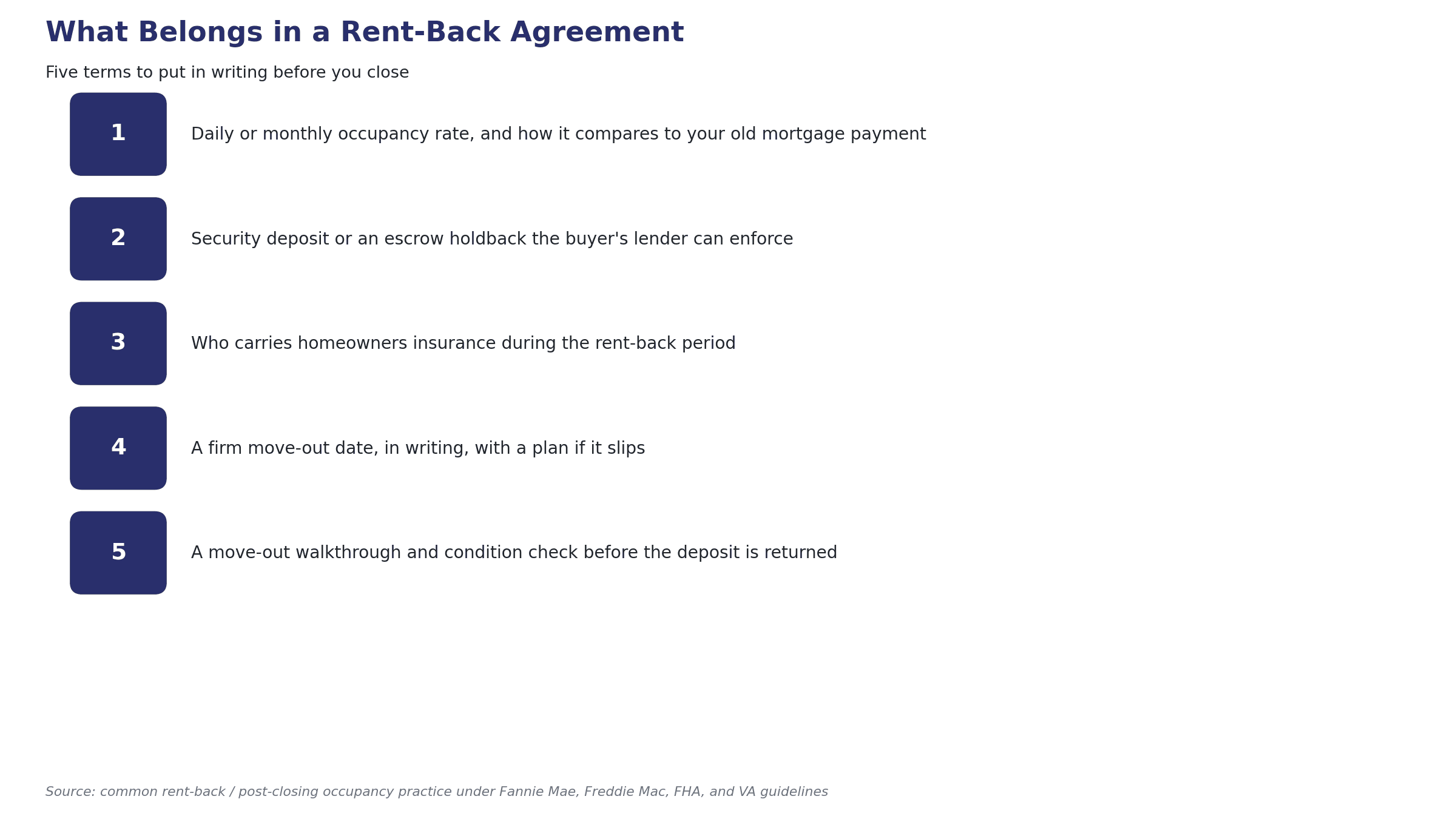
Checklist of five terms to put in a rent-back agreement: rate, deposit, insurance, move-out date, and final walkthrough

Put every one of these in writing before you accept an offer that includes a rent-back.

What a Rent-Back Costs

Expect to pay rent for the days you stay, and expect that daily rate to run higher than your old mortgage payment was. A short rent-back is usually still cheaper than a hotel plus a short-term storage unit plus a second cross-country trip, which is the real comparison for most PCSing families juggling report dates.

Some buyers waive rent for a few days as a negotiating point, especially in a market where sellers have leverage. In a market where buyers have more leverage, expect to pay closer to market rent or slightly above it, since you are asking the buyer to delay moving into their own home.

How Long Can You Stay? The 60-Day Rule

Most owner-occupied loans, including conventional loans backed by Fannie Mae or Freddie Mac and FHA loans, cap a rent-back at 60 days after closing. The buyer's lender needs the buyer to move in and certify the home as their primary residence within that window, so a seller's rent-back has to end before that clock runs out. Some lenders apply a tighter internal limit, closer to 30 days, so ask your buyer's agent what their lender allows before you build a moving timeline around 60 days.
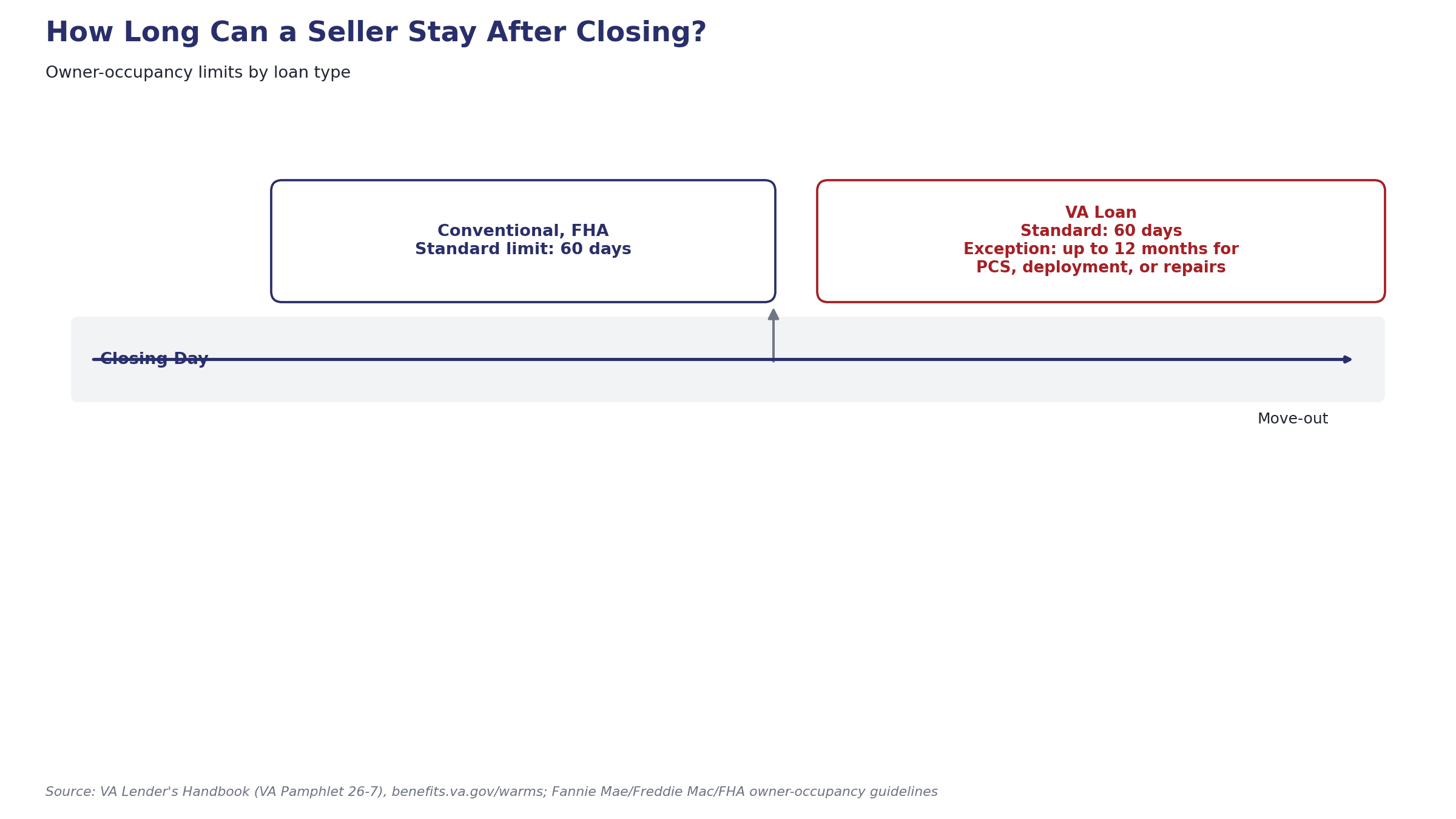
Timeline showing a 60-day occupancy limit for conventional and FHA buyers, and a VA loan exception allowing up to 12 months for PCS, deployment, or repairs

A VA-financed buyer has more flexibility than the standard 60-day rule when their own move is tied to orders. Source: VA Lender's Handbook, VA Pamphlet 26-7.

The VA Loan Exception That Helps Military Buyers and Sellers

If your buyer is using a VA loan, there is more room than the standard rule suggests. VA guidelines still expect occupancy within 60 days as the default, but they allow delayed occupancy up to 12 months when a documented reason applies: the buyer is retiring or PCSing within the next year with orders in hand, active-duty deployment, or repairs the home needs before it is livable. A deployed service member's spouse can also satisfy the occupancy requirement in their place.


Buying Or Selling

That flexibility runs in the buyer's favor, not automatically in yours as the seller, but it matters if you are the one buying your next home with a VA loan while still finishing out a rent-back on the place you sold. Our VA loan occupancy requirements guide walks through the full rule set and how to document an exception with your lender.

Building a Rent-Back Into Your PCS Timeline

If you know a PCS is coming, raise a possible rent-back with your agent before you list, not after an offer lands on your desk. It changes how you price and market the home, since some buyers, particularly investors or those without a hard move-in date of their own, are more open to it than an owner-occupant buyer racing their own moving truck.

Connect with a VeteranPCS agent early in your listing process so a rent-back clause is built into your strategy from the start, not negotiated under pressure after you already have a signed contract. Our ultimate PCS checklist and timeline is a good place to map your report date against a realistic closing window, and if your timeline is especially tight, our 30-day short-notice PCS plan covers the compressed version of this same problem.

Frequently Asked Questions

Is a rent-back agreement the same as renting the home back long-term?

No. A rent-back is a short, defined bridge, typically days to a few weeks, built to smooth a closing-to-move-out gap. It is not a long-term lease-back arrangement, and most conventional and FHA lenders cap it at 60 days.

Who pays for repairs during a rent-back period?

This should be spelled out in the agreement itself. Many rent-backs keep the seller responsible for the home as if they still owned it day to day, while the buyer's insurance takes over the underlying property coverage the moment they hold title.

Can I negotiate a rent-back for free, with no rent charged?

You can ask. Whether a buyer agrees usually comes down to how competitive the local market is and how much flexibility the buyer's own move allows. Your agent can tell you what is realistic in your specific market.

Does a rent-back affect my home sale proceeds?

The rent you pay during the rent-back period is separate from your sale proceeds; it does not reduce what you were paid at closing, though a security deposit held in escrow is not released to you until you move out and the walkthrough clears.

Reach a VeteranPCS agent to talk through whether a rent-back fits your PCS timeline before you list your home.

This content is for informational purposes. Consult a professional for personal financial decisions.

Share this with a service member selling a home on a tight PCS timeline.

Up next

Looking for something else?

Search all VeteranPCS PCS and VA loan guides.

PCS Frequently Asked Questions

    Keep In Touch

    No spam mail, no fees. VeteranPCS is free to use.

    Fields marked with an asterisk (*) are required.

    Find an agent