Taking a TSP loan for a home down payment is one of the most common questions military buyers ask, usually about three weeks before closing when the cash-to-close number gets real. The Thrift Savings Plan, or TSP, is the federal government's retirement savings plan for civilian employees and uniformed service members, and yes, you can borrow from it to buy a home. Whether you should is a different question, and the answer for a lot of VA loan borrowers is no.
This guide covers the actual rules from TSP.gov, what the loan can and cannot pay for, and the one question to answer before you take money out of your retirement account.
The Two Kinds of TSP Loan
TSP allows two loan types, and they are not interchangeable.
| General purpose loan | Primary residence loan | |
|---|---|---|
| Allowed use | Any purpose | Future purchase or construction of a primary residence, and only for costs still needed to close |
| Documentation | None required | Required |
| Repayment term | 12 to 60 months | 61 to 180 months |
| Processing fee | $50 | $100 |
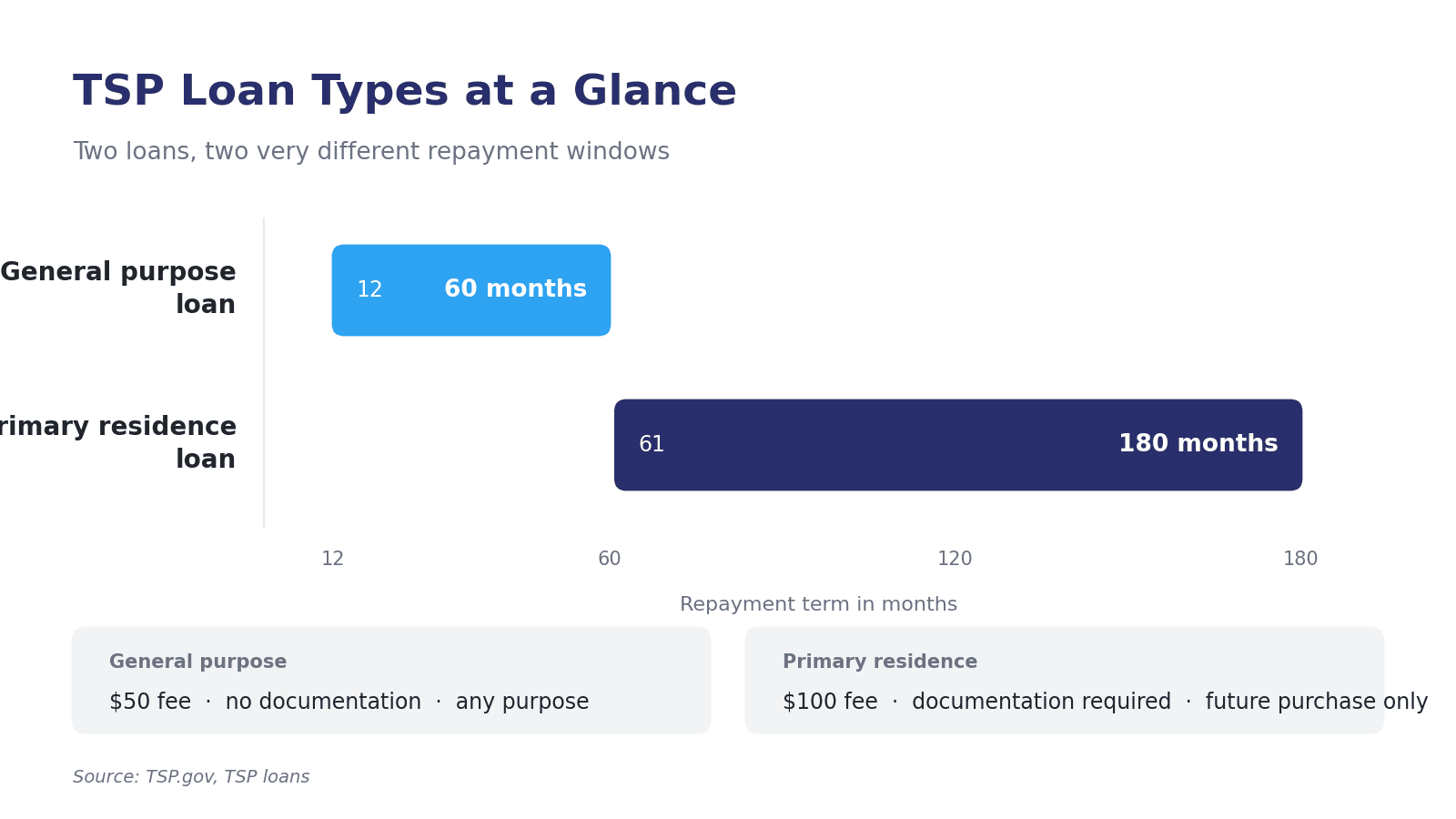
The residential loan buys you a longer runway. The general purpose loan buys you flexibility. Source: TSP.gov.
The residential loan's long term is its real advantage. Spreading repayment over up to 15 years keeps the payroll deduction small. The general purpose loan has to be repaid in five years or less, which makes the monthly bite much larger for the same amount borrowed.
You may have only one general purpose loan and one residential loan outstanding at a time.
What a Residential Loan Cannot Pay For
This is where most plans fall apart, and it is worth reading twice. A TSP primary residence loan can only be used for the future purchase or construction of a primary residence, and only for costs still needed to close.
Per TSP, you cannot use it for:
- Reimbursing yourself for money already spent, including earnest money or a deposit you already put toward your down payment
- Refinancing or prepaying an existing mortgage
- Building an addition onto your current home
- Renovations to your current home
- Buying out another person's share of your current residence
- Purchasing land only
- Purchasing a house you have already closed on
Read the first and last items together. If you close first and plan to backfill your savings with a TSP loan afterward, that is not allowed. The timing has to run the other direction, and the property must be one you or your spouse are purchasing in whole or in part.
Eligible property types include a house, townhouse, condominium, shares in a cooperative housing corporation, or a mobile home, as long as it will be your primary residence.
Borrowing Limits
The minimum you can borrow is $1,000. The maximum is the smallest of three numbers.
- Your own contributions and the earnings on them in the account you are borrowing from, not counting any outstanding loan balance
- Fifty percent of the portion of your total balance made up of your own contributions and their earnings including any outstanding loan balance, or $10,000, whichever is greater, minus any outstanding loan balance
- $50,000 minus your highest outstanding loan balance during the last 12 months
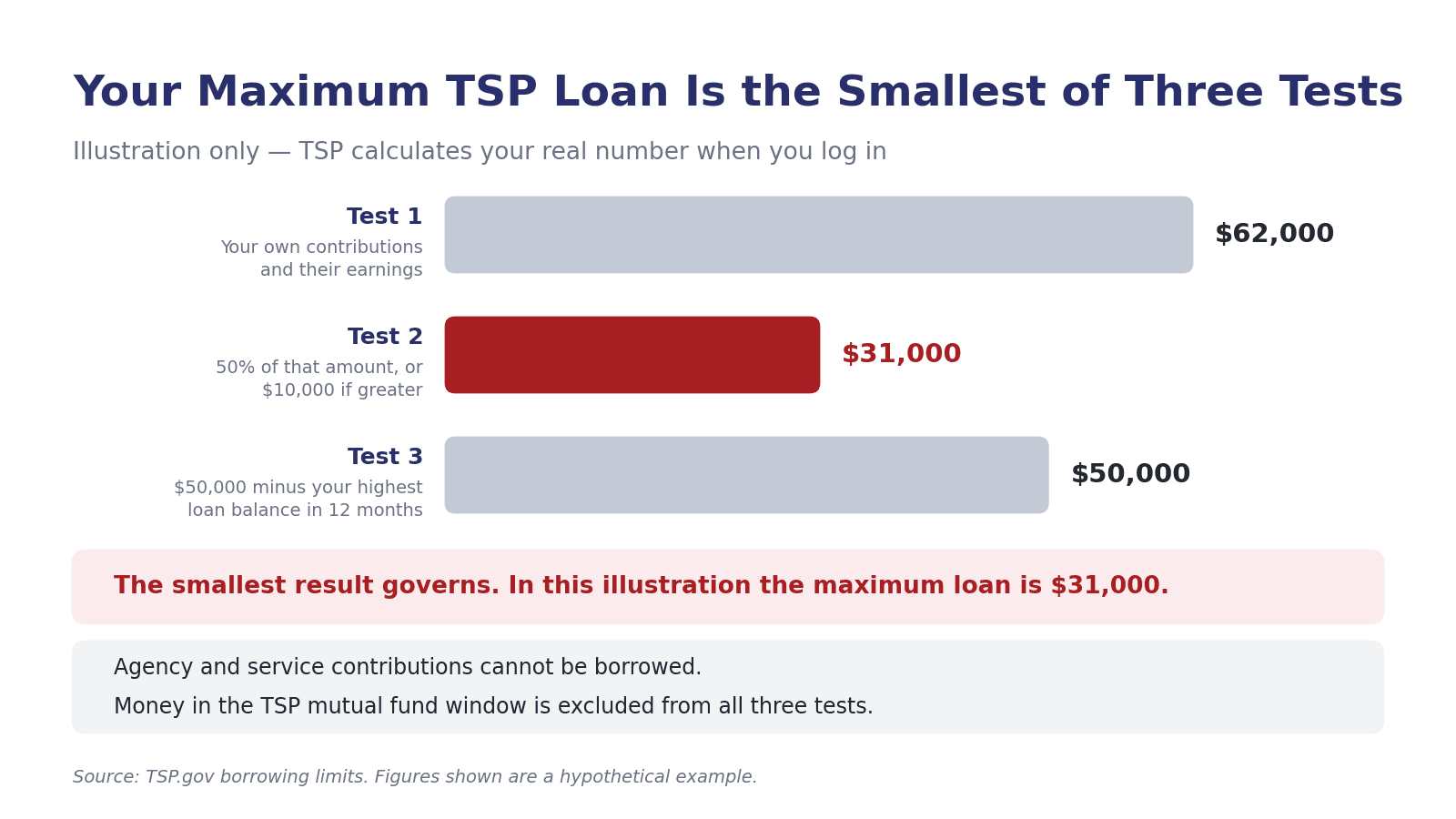
An illustration only. TSP applies all three tests and the smallest result is your maximum.
Two limits catch service members specifically. Agency and service contributions and their earnings cannot be borrowed, only your own. And money invested through the TSP mutual fund window is excluded from all three calculations, so if a chunk of your balance sits there, your borrowing power is lower than your account statement suggests.
You also need at least $1,000 of your own contributions and associated earnings, you must currently be in federal service or the uniformed services and in pay status, and you cannot have repaid a TSP loan in full within the past 30 business days.
What It Costs
The costs are not obvious, because a TSP loan looks like you are just paying yourself.
The interest rate is the G Fund rate for the month before you request the loan, and it stays the same for the life of the loan. Check the current figure on the TSP loans page, since the G Fund rate moves month to month.
The processing fee is $100 for a primary residence loan. It comes out of the loan amount, you repay the full face amount, and the fee is never returned to your account.
The real cost is the one that does not appear on a statement. Money that leaves your TSP stops earning market returns while it is out. TSP puts it directly: you will be missing out on the compound earnings that money could otherwise have accrued. Over a 15-year residential loan, that gap can dwarf the $100 fee.