If you are shopping for a home this year, you have probably seen headlines about the 2026 VA loan limits. The numbers sound big and a little scary, and many military buyers worry they cap how much house they can buy. Here is the good news: for most veterans and service members, these limits do not apply at all. This guide explains what the limits are, when they actually matter, and why a VA (Department of Veterans Affairs) loan can be one of the most flexible ways to buy a home.
A PCS (Permanent Change of Station) move adds enough stress on its own. You should not have to guess about your buying power, too. Let's clear up the confusion in plain language.
What Are the 2026 VA Loan Limits?
VA loan limits are tied to the conforming loan limits set each year by the FHFA (Federal Housing Finance Agency). The FHFA raises these limits to keep up with rising home prices across the country.
For 2026, the FHFA announced on November 25, 2025 that the baseline limit for a one-unit home is $832,750. That is up from $806,500 in 2025. In high-cost areas, where home prices run much higher, the ceiling for a one-unit home is $1,249,125. A few places, including Alaska, Hawaii, Guam, and the U.S. Virgin Islands, use the higher ceiling as their baseline.
The VA uses these same conforming loan limit numbers. So when you see a "2026 VA loan limit" for your county, it is really the FHFA one-unit figure for that area.
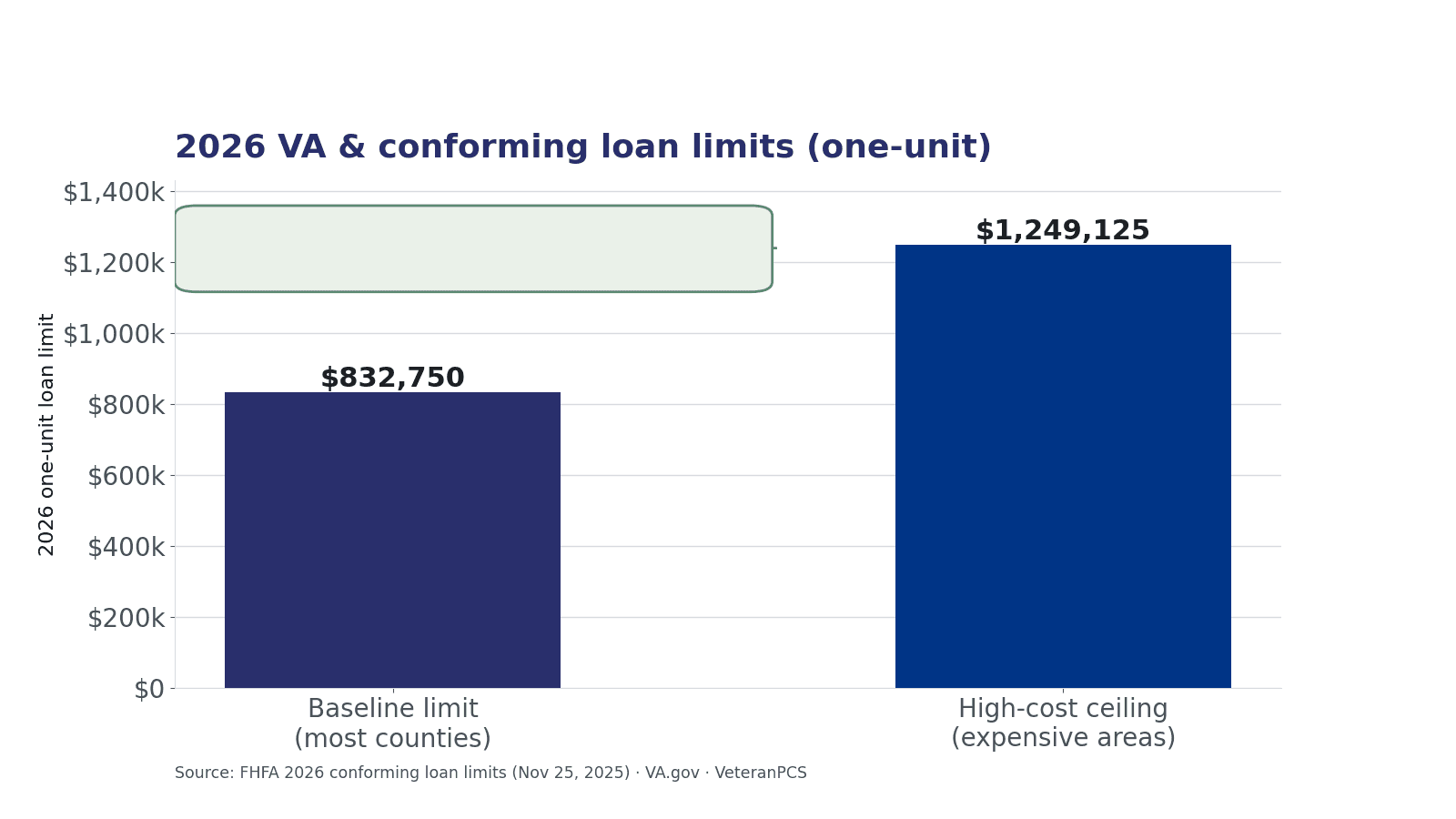
The 2026 limits apply only to partial entitlement. With full entitlement there is no VA loan limit.
Here Is the Part Most People Miss: Limits Only Apply Sometimes
This is the most important point in this article, so read it twice. The 2026 VA loan limits do not apply to veterans with full entitlement.
Back in 2019, Congress passed the Blue Water Navy Vietnam Veterans Act. Starting January 1, 2020, that law removed VA loan limits for borrowers with full entitlement. In other words, if you have full entitlement, there is no cap on how much you can borrow with no money down. You are not boxed in by the $832,750 figure or your county number.
There is one honest catch. The VA does not cap your loan, but your lender still has to approve you. A lender looks at your credit history, your income, your debts, and your savings to decide how much you can comfortably repay. The home also has to appraise for at least the purchase price. So "no limit" means no government cap, not unlimited money. To learn more about how this benefit works, see our guide on the benefits of a VA loan.
Full Entitlement vs. Partial Entitlement
Entitlement is the amount the VA promises to repay your lender if you ever default. It is the engine behind your zero-down benefit. You can confirm your entitlement on your COE (Certificate of Eligibility), the document that proves you qualify for a VA loan.
You likely have full entitlement if you have never used your VA loan benefit, or if you used it before and have since paid the loan in full and sold the home. With full entitlement, the loan limits do not apply, and you can buy with no down payment as long as your lender approves you.
You have partial (reduced) entitlement if some of your entitlement is still tied up. This usually happens when you have an active VA loan right now, when you bought with a VA loan and still owe on it, or when you had a past VA loan that ended in a default or short sale. In these cases, the 2026 VA loan limits do matter, because they help decide how much you can still borrow with no money down.
For a deeper walk-through of how this works, read our companion guide on how VA loan entitlement works.
How Limits Work With Partial Entitlement
When you have partial entitlement, the VA uses your county loan limit to figure your remaining benefit. This is sometimes called second-tier or bonus entitlement, and it lets many borrowers use the VA loan a second time without losing the zero-down advantage.
Here is the basic math the VA uses. First, take your county one-unit loan limit and multiply it by 25 percent. Then subtract the entitlement you have already used. The result is your remaining entitlement. Lenders generally want your entitlement and any down payment to cover at least 25 percent of the new loan.