

If you have been through a foreclosure or bankruptcy, you may believe your VA loan benefit is gone for good. It is not. A VA loan after foreclosure or bankruptcy is not only possible, it is often faster than qualifying for a conventional loan again. The Department of Veterans Affairs built the program to help service members and veterans recover, and that includes bouncing back from a serious financial setback. This guide covers the 2026 waiting periods, how to restore your entitlement, and the steps to qualify again.
Your VA Loan Benefit Does Not Disappear
Here is the most important thing to understand: a foreclosure, short sale, or bankruptcy does not permanently take away your VA home loan benefit. As the VA puts it plainly, even losing a VA loan to foreclosure does not mean you are no longer eligible, according to VA News. You may need to wait, rebuild your credit, and in some cases restore part of your entitlement, but the door stays open.
That matters because the alternative, waiting years for a conventional loan, keeps too many veterans renting when they could be buying.
2026 VA Loan Waiting Periods
The VA and its lenders use standard waiting periods after a credit event. These are the typical timelines, drawn from VA guidance:
| Credit event | Typical VA waiting period |
|---|---|
| Chapter 7 bankruptcy | 2 years from discharge |
| Chapter 13 bankruptcy | 1 year of on-time payments |
| Foreclosure | 2 years |
| Short sale or deed-in-lieu | No VA-set waiting period |
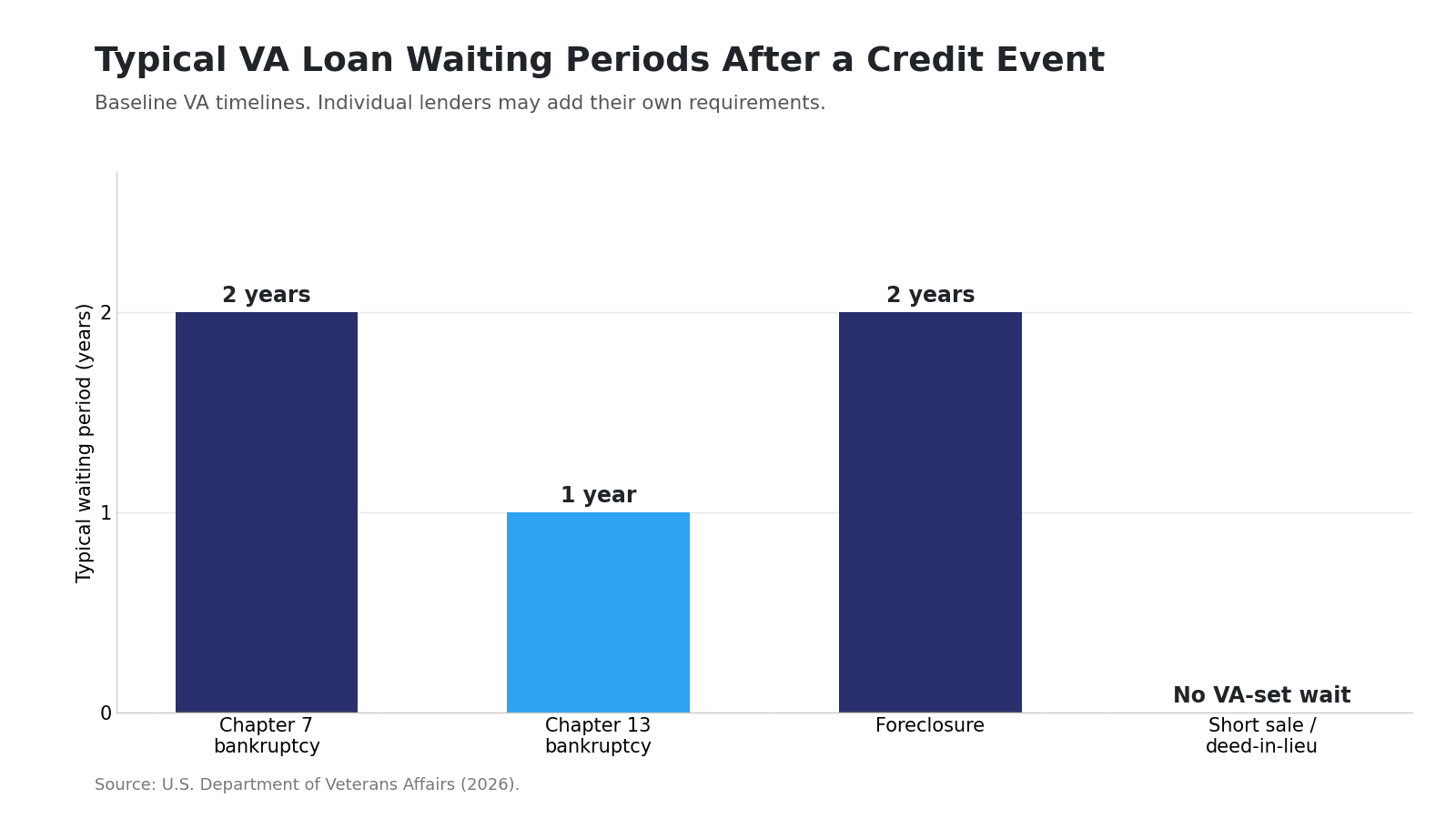 Typical VA loan waiting periods after a credit event. Lenders may add their own requirements. Source: Department of Veterans Affairs.
Two points are worth stressing. First, with a Chapter 13 bankruptcy, you may be able to qualify after just 12 months of on-time payments, often with approval from the bankruptcy trustee or court. Second, these are the VA's baseline timelines. Individual lenders can add stricter rules, called overlays, so one lender may say yes when another says wait. For comparison, conventional loans often require a four- to seven-year wait after these same events, per VA News.
Restoring Your Entitlement
If the home you lost was financed with a VA loan, there is an extra step called restoration of entitlement. Your entitlement is the portion of a loan the VA guarantees, and when a VA loan ends in foreclosure, short sale, or deed-in-lieu, part of that entitlement stays tied up until you make the VA whole.
To fully restore it, you generally need to repay the amount the VA lost on the loan, according to the VA. You can request your remaining entitlement and restoration through the VA Eligibility Center using VA Form 26-1880, and a VA loan technician can tell you the exact amount owed. It is worth learning how VA loan entitlement works before you apply, because even without full restoration you may have enough remaining, or "second-tier," entitlement to buy again with little or no money down.
Planning Your Next Move?
Connect with Veteran & Military Spouse Real Estate Agents and VA Loan Experts You Can Trust.
If you never lost a VA-financed home, restoration usually is not an issue, and you can move straight to rebuilding your credit and getting a fresh Certificate of Eligibility.
How to Qualify Again
Waiting out the clock is only part of the job. Lenders want to see that the setback is behind you and that you are managing money well now.
Rebuild your credit steadily. There is no VA-set minimum score, but most VA lenders look for a credit score around 620, so on-time payments and low balances matter. Our guide to VA loan credit score requirements explains what lenders weigh, and our guide to building and maintaining strong credit lays out a plan.
Document what happened. If your foreclosure or bankruptcy came from something outside your control, such as a medical crisis, a job loss, or a deployment-related hardship, write it down. Lenders can weigh those circumstances.
Save a small cushion. You still may not need a down payment, but reserves and a handle on closing costs show stability and strengthen your file.
Once you are ready, a VeteranPCS lender who works with veterans every day can review your timeline and tell you exactly where you stand. When it is time to shop, a VeteranPCS agent can guide the search.
Avoiding Foreclosure in the First Place
If you are behind on a mortgage right now and have not yet lost the home, contact the VA before anything is final. The VA's Loan Guaranty Service tracks VA loans and has foreclosure-avoidance specialists who work directly with your servicer to find alternatives, and it offers programs to help veterans stay in their homes, per the VA. Acting early gives you the most options and can protect your future benefit.
Free First-Time Homebuyer Guide
Make your move less stressful with our step-by-step first-time homebuyer guide.
We respect your privacy. Unsubscribe anytime.Frequently Asked Questions
Can I get a VA loan after foreclosure?
Yes. The typical waiting period is two years after a foreclosure. If the foreclosed home was financed with a VA loan, you may also need to restore your entitlement by repaying the VA's loss.
How long after Chapter 7 bankruptcy can I use a VA loan?
Usually two years after your Chapter 7 discharge, assuming you have re-established good credit. Some lenders may consider you sooner with documented circumstances beyond your control.
Is there a waiting period after a short sale for a VA loan?
The VA does not set a waiting period after a short sale or deed-in-lieu, though individual lenders may add their own requirements.
Do I lose my VA loan benefit if I had a foreclosure?
No. Your benefit remains. You may need to wait, rebuild credit, and restore any entitlement tied to a lost VA loan, but you can use the benefit again.
The Bottom Line
A VA loan after foreclosure or bankruptcy is well within reach. Know your waiting period, restore your entitlement if a VA loan was involved, and rebuild your credit so you are ready when the clock runs out. When you want a clear read on your timeline, connect with a VeteranPCS lender who understands veteran recovery stories, and reach a VeteranPCS agent when you are ready to buy again. Share this guide with a fellow veteran who thinks their benefit is gone.
This content is for informational purposes. Consult a professional for personal financial decisions.