Your first set of orders has arrived, and you are about to PCS to your first duty station. PCS stands for Permanent Change of Station, the military term for moving from one assignment to another. The first move is the one that feels the most unfamiliar, because you are learning the words, the paperwork, and the pace all at once. This guide breaks down what to expect and the benefits you have earned, so your first duty station move starts on solid footing.
A first move has more moving parts than most people expect, but the military gives you real support to make it happen. The key is knowing what you are entitled to and lining it up early.
Start With Your Orders and Your Sponsor
Everything flows from your orders. Read them closely and note your report date, your new unit, and any reporting instructions. Your orders also set your entitlements, so keep several copies, both paper and digital.
Most gaining units assign a sponsor, a service member already at your new base who helps you get oriented. Reach out early. A good sponsor can answer questions about housing, the area, and what to do in your first week. If you have not heard from one, ask your unit to assign you a sponsor.
Understand Your PCS Entitlements
The military helps pay to move you and your belongings. Your exact benefits depend on your rank, your dependents, and whether your move is within the continental United States, or CONUS, or overseas, known as OCONUS. The Defense Department's PCS entitlements overview from Military OneSource is the plain-language starting point, and your local transportation office confirms the specifics for your move.
Here are the benefits new service members ask about most.
Dislocation Allowance, or DLA, helps offset the costs of relocating your household. The amount is set by pay grade and dependent status. As of the rates effective January 1, 2025, an E-5 with dependents receives about $3,418, and an O-3 with dependents about $3,894, according to the Defense Travel Management Office. These rates update each January, so check the current figure for your grade.
Temporary Lodging Expense, or TLE, helps cover lodging and meals while you are between homes during a CONUS move. As of late 2024, service members can receive TLE for up to 21 days, according to the Defense Travel Management Office. For overseas moves, a similar benefit called Temporary Lodging Allowance applies. We break the details down in our guide to Temporary Lodging Expense for PCS moves.
Travel reimbursement covers your trip to the new base. If you drive, you are paid a set rate per mile through the Monetary Allowance in Lieu of Transportation, or MALT, plus a per diem for travel days. The current MALT rate is published on the DTMO mileage rates page.
A household goods shipment moves your belongings, with a weight limit based on your rank. You can also choose a personally procured move, or PPM, sometimes called a DITY move, where you move yourself and may earn an incentive payment. Our 2026 PPM move guide explains how that payout works. You can move up to 2,000 pounds of professional gear on top of your weight allowance, and a spouse can move up to 500 pounds, according to Military OneSource.
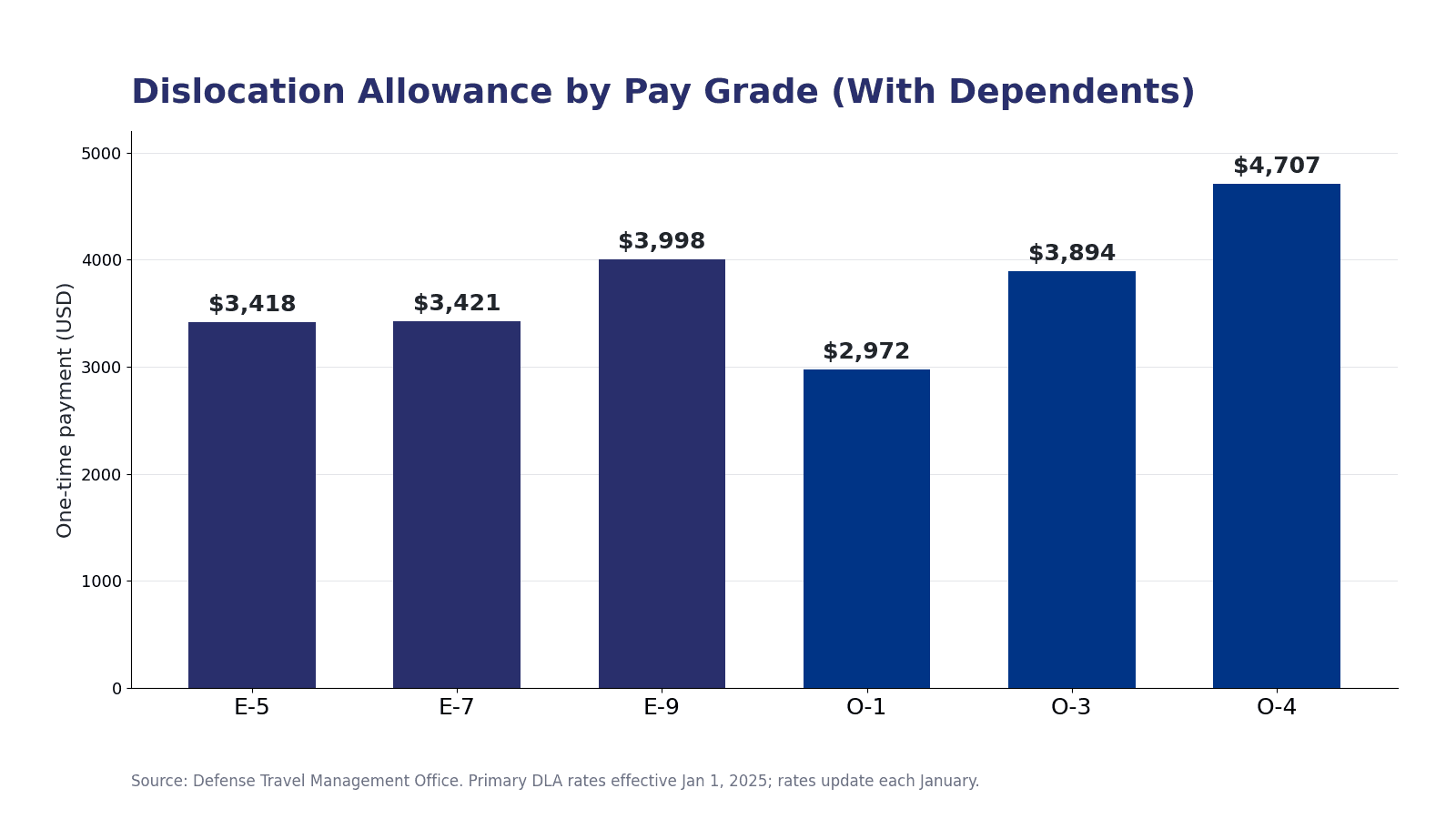
Sample Dislocation Allowance amounts (with dependents), effective January 1, 2025. Source: Defense Travel Management Office. Rates update each January.
Decide Where You Will Live
You generally have two paths: on-base housing or living off base. On-base housing can be convenient and may have a wait list, so contact the housing office early. If you live off base, the military helps with rent through BAH, which stands for Basic Allowance for Housing, a monthly, tax-free payment based on your rank, your dependents, and the local market.
Before you sign a lease or tour homes, look up your rate. Our 2026 BAH guide shows how to find your exact figure with the official calculator. If you are not yet sure which installation you are even searching around, our overview of how to find military bases near you by state can help you get oriented.