VA Loan vs. Conventional Loan: Which Is Better for Military Buyers?

By VeteranPCS

If you have earned a VA (Department of Veterans Affairs) home loan benefit, you may still wonder whether it beats a regular mortgage. The VA loan vs conventional loan question comes up on almost every military home search, and the honest answer is that it depends on your down payment, your credit, and your goals. This guide puts the two loans side by side in plain language so you can walk into a lender meeting knowing which questions to ask.

The Basic Difference

A VA loan is a mortgage backed by the Department of Veterans Affairs and offered to eligible service members, veterans, and some surviving spouses. The VA does not lend the money; it guarantees part of the loan so a private lender can offer better terms.

A conventional loan is a mortgage that is not backed by any government agency. Most conventional loans follow rules set by Fannie Mae and Freddie Mac, the two companies that buy loans from lenders. Anyone can apply for one, military or not.

The VA loan is a benefit you earned through service. If you qualify, it usually offers the lowest cost of entry. But it is not always the winner, so it helps to compare the details. If you are new to the benefit, start with our overview of the benefits of a VA loan.

Down Payment and Mortgage Insurance

This is the biggest gap between the two loans, and where most military buyers save.

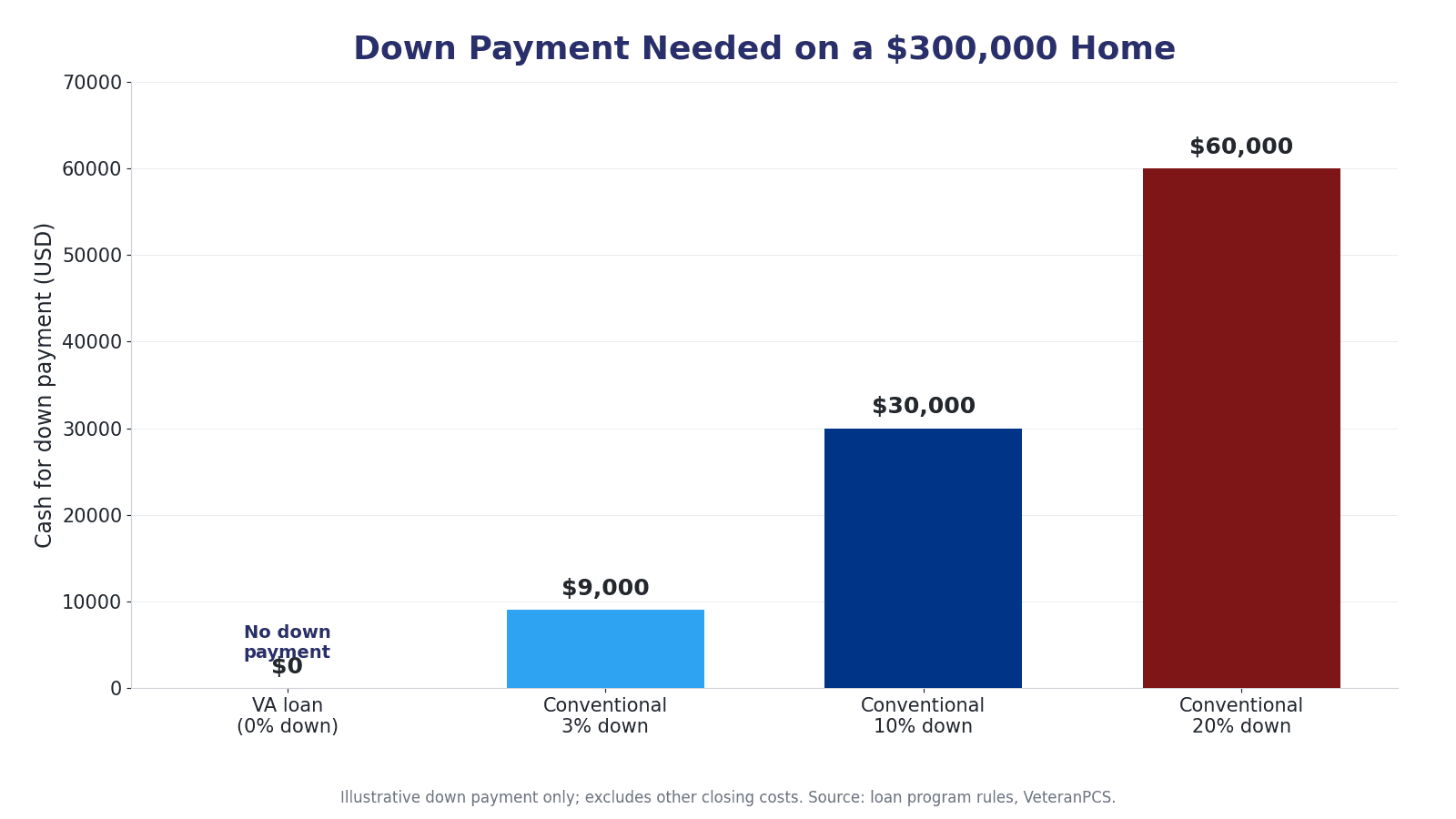
A VA loan lets eligible buyers purchase with no down payment and charges no monthly mortgage insurance. A conventional loan can go as low as 3 percent down for some buyers, but if you put down less than 20 percent, you pay private mortgage insurance, or PMI. According to the Consumer Financial Protection Bureau, your servicer must automatically cancel PMI once your balance reaches 78 percent of the home's original value, and you can ask to cancel it at 20 percent equity. Until then, PMI adds to your payment every month.

FeatureVA loanConventional loan
Minimum down payment0%Usually 3%
Monthly mortgage insuranceNonePMI if less than 20% down
One-time feeVA funding feeNone
Backed byDepartment of Veterans AffairsFannie Mae / Freddie Mac

Bar chart comparing cash needed at closing on a $300,000 home for a VA loan versus conventional loans with 3, 10, and 20 percent down.

Estimated cash to close on a $300,000 home. The VA loan removes the down payment, the largest upfront cost. Figures are illustrative and exclude other closing costs.

To see how the no-down-payment benefit works in practice, read our guide to how a $0 down VA loan works.

The VA Funding Fee vs. PMI

The VA loan trades monthly mortgage insurance for a one-time charge called the funding fee. This fee keeps the program running for future service members. Per VA.gov, the purchase funding fee is 2.15 percent of the loan for first-time users who put nothing down, and it drops if you make a down payment.

Down paymentFirst useAfter first use
Less than 5%2.15%3.3%
5% or more1.5%1.5%
10% or more1.25%1.25%

Source: VA.gov funding fee rates, effective April 7, 2023.

Two points matter here. First, you can roll the funding fee into your loan instead of paying cash. Second, many buyers pay no funding fee at all: VA.gov exempts anyone receiving VA compensation for a service-connected disability, among others. Learn more in our complete guide to the VA funding fee. PMI, by contrast, is never refunded once paid and continues until you reach the equity marks above.

Credit Score and Qualifying

The VA does not set a minimum credit score. As VA.gov notes, individual lenders may set their own, so it pays to compare more than one. Conventional loans generally look for a score around 620 or higher, and your rate improves as your score climbs.

VA loans also tend to be more flexible on debt-to-income ratio and use a "residual income" test that looks at the cash left over after your bills. For a deeper look, see our guide to VA loan credit score requirements.

VA Loan Expert

Loan Limits and Property Type

If you have full entitlement, the VA sets no loan limit. As VA.gov explains, you can borrow as much as a lender approves and the appraisal supports, with no cap. Conventional loans follow the conforming loan limit, which the Federal Housing Finance Agency set at $832,750 for a one-unit home in most of the country in 2026. Borrow more than that and you move into a jumbo loan with stricter rules.

The trade-off: a VA loan must be for a home you will live in, not a rental or vacation house. A conventional loan can finance a second home or an investment property. If a rental is your goal, the conventional loan may be the only fit. Curious how full entitlement works? Read our 2026 VA loan limits explainer.

Interest Rates

VA loans often carry interest rates at or slightly below comparable conventional rates, in part because the VA guaranty lowers a lender's risk. The gap changes with the market and your credit, so always compare Loan Estimates from more than one lender before you decide. A lower rate plus no PMI can make the VA loan the cheaper monthly option even when the funding fee is added in.

When a Conventional Loan Might Win

The VA loan is not always the answer. A conventional loan may be the better move if you:

  • Plan to buy a rental property or second home, which a VA loan cannot cover.
  • Can put down 20 percent or more, which erases PMI and may beat the funding fee over time.
  • Are exempt from the funding fee but want to keep your VA entitlement free for a later purchase.
  • Are buying a condo or property that does not meet the VA appraisal's minimum property requirements.

Not sure a VA loan is right for your situation? Our post on whether a VA loan always has the best rate walks through the math, and if you are weighing a low-down-payment government option, compare our VA loan vs. FHA loan guide.

Working with an agent and lender who know both loans is the fastest way to see your real numbers. Connect with a VeteranPCS lender for a side-by-side Loan Estimate on your next home.

Frequently Asked Questions

Is a VA loan better than a conventional loan? For most eligible buyers with less than 20 percent to put down, yes. No down payment and no monthly mortgage insurance usually make the VA loan cheaper to enter and to carry. A conventional loan can win if you put 20 percent down or want a property a VA loan cannot finance.

Do VA loans have higher interest rates than conventional loans? No. VA loan rates are often at or slightly below comparable conventional rates because the VA guaranty reduces lender risk. Always compare offers from several lenders.

Can I avoid the VA funding fee? Yes, if you receive VA compensation for a service-connected disability or meet another exemption listed on VA.gov. You can also roll the fee into the loan instead of paying cash.

Can I use a conventional loan and keep my VA benefit? Yes. Your VA loan entitlement does not expire and can be used later. Some buyers save the benefit for a future purchase.

The Bottom Line

The VA loan vs conventional loan choice comes down to your cash, your credit, and your plans. The VA loan usually wins on upfront cost with no down payment, no PMI, and competitive rates. A conventional loan makes sense for investment properties, large down payments, or homes that do not fit VA rules. Run both sets of numbers before you commit.

Find a military-experienced agent who can help you shop with confidence, or connect with a VeteranPCS lender to compare a VA loan and a conventional loan on your own budget.

Know a fellow service member weighing their options? Share this guide with your military network.

This content is for informational purposes. Consult a professional for personal financial decisions.

Up next

Looking for something else?

Search all VeteranPCS PCS and VA loan guides.

PCS Frequently Asked Questions

    Keep In Touch

    No spam mail, no fees. VeteranPCS is free to use.

    Fields marked with an asterisk (*) are required.

    Find a lender