VA Specially Adapted Housing (SAH) Grants: A 2026 Guide

By VeteranPCS

If a service-connected disability makes it hard to move around your home, the VA (Department of Veterans Affairs) may help pay to buy, build, or change a home that fits your needs. The Specially Adapted Housing grant, or SAH grant, is one of the most valuable benefits many veterans never hear about. This guide explains the 2026 grant amounts, who qualifies, and how a grant can work alongside your VA home loan.

What Is the Specially Adapted Housing Grant?

The SAH grant is money from the VA that helps veterans and service members with certain severe service-connected disabilities live more independently. You can use it to buy a home already adapted for your needs, build a new adapted home, or modify a home you own by adding features like ramps, wider doorways, or a roll-in shower.

There are actually three related programs, as VA.gov explains: the Specially Adapted Housing (SAH) grant, the Special Home Adaptation (SHA) grant, and the Temporary Residence Adaptation (TRA) grant. Which one fits depends on your disability and whether the home is yours or a family member's.

2026 Grant Amounts

The VA adjusts the maximum grant each year based on construction costs. For fiscal year 2026, the maximum amounts are below.

GrantMaximum for FY 2026
Specially Adapted Housing (SAH)$126,526
Special Home Adaptation (SHA)$25,350
TRA (for those SAH-eligible)$50,961
TRA (for those SHA-eligible)$9,100

Source: VA.gov disability housing grants, fiscal year 2026 (October 1, 2025 through September 30, 2026).
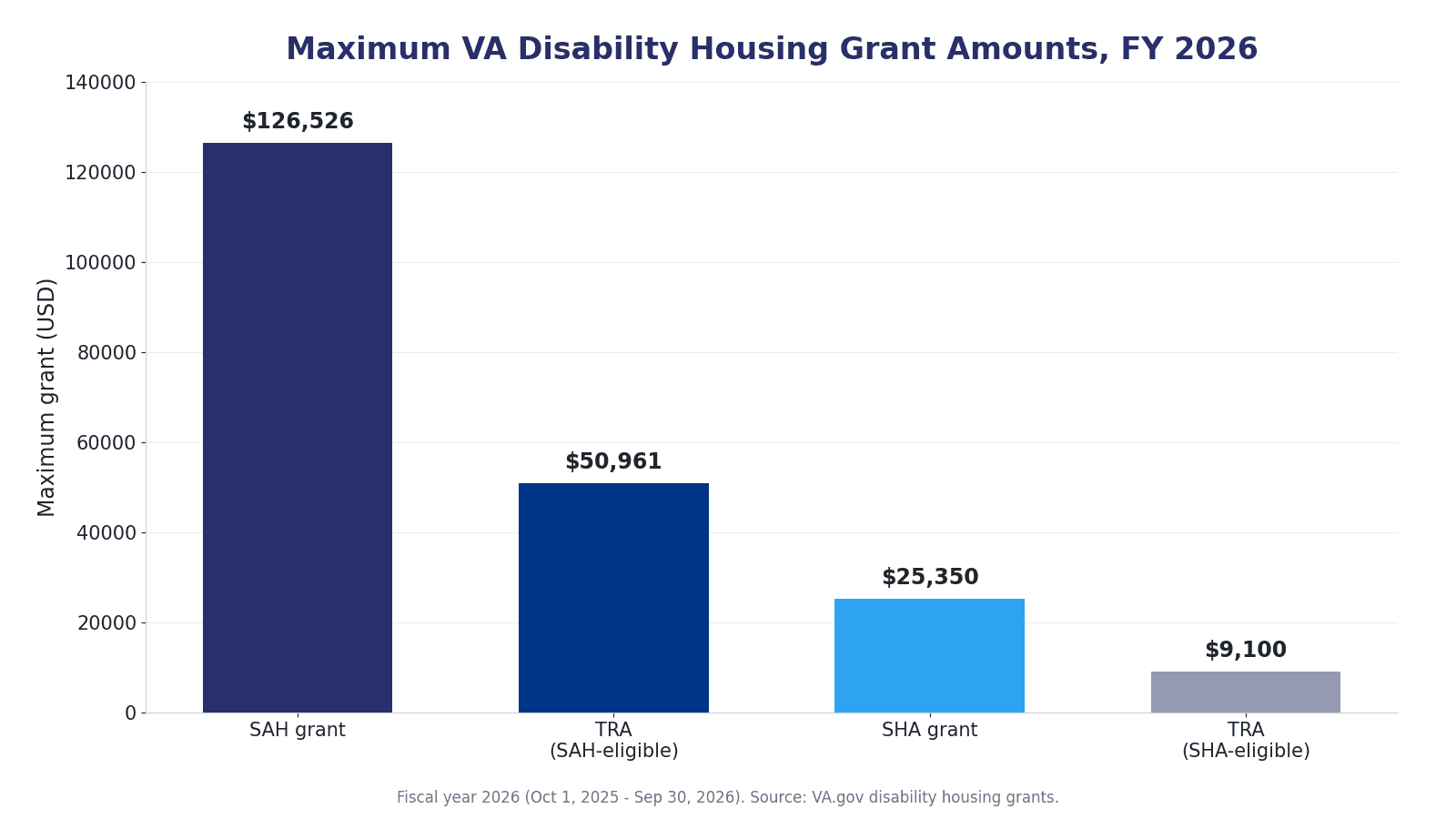
Bar chart of the 2026 maximum VA housing grant amounts for SAH, SHA, and both temporary residence adaptation grants.

Maximum VA disability housing grant amounts for fiscal year 2026. Source: VA.gov.

You do not have to use the full amount at once. Per VA.gov, you can draw on an SAH or SHA grant up to six times over your lifetime, up to the total maximum.

Who Qualifies for an SAH Grant

To get an SAH grant, you must own or plan to own the home and have a qualifying service-connected disability. According to VA.gov, qualifying disabilities include:

  • The loss, or loss of use, of more than one limb
  • The loss, or loss of use, of a lower leg along with the lasting effects of a natural disease or injury
  • Blindness in both eyes, with 20/200 visual acuity or less
  • Certain severe burns
  • The loss, or loss of use, of one lower leg or foot after September 11, 2001, that makes it hard to balance or walk without braces, crutches, canes, or a wheelchair

Who Qualifies for an SHA Grant

The smaller SHA grant helps with adaptations for a different set of disabilities. You or a family member must own the home, and your qualifying disability, per VA.gov, must include one of these:

  • The loss or loss of use of both hands
  • Certain severe burns
  • Certain respiratory or breathing injuries

The Temporary Residence Adaptation (TRA) Grant

VA Loan Expert

If you are living temporarily in a family member's home that needs changes to fit your needs, the TRA grant can help pay for those adaptations even though you do not own the house. You qualify for a TRA grant if you are eligible for an SAH or SHA grant. The maximum TRA amount depends on which grant you qualify for, as shown in the table above.

Using a Grant With Your VA Home Loan

A housing grant is separate from your VA home loan, and the two can work together. You might use a VA loan to buy a home with no down payment and a grant to adapt it. Many grant-eligible veterans also qualify for a VA funding fee exemption, since receiving compensation for a service-connected disability removes that fee entirely. See how that works in our complete guide to the VA funding fee.

If you are buying your first home, pair this benefit with our complete guide to buying your first home with a VA loan and our overview of the benefits of a VA loan. Disabled veterans often stack savings: many states also offer property tax breaks, such as Florida's veteran property tax exemptions.

How to Apply

You apply for a housing grant with VA Form 26-4555. Per VA.gov, you can apply online, by mail, or in person, and a VA agent will guide you through choosing a contractor and approving the plans. Working with a VeteranPCS agent who knows accessible housing can also help you find a home that is easier and cheaper to adapt in the first place.

Planning a move and think you may qualify? Connect with a VeteranPCS agent who can help you find an accessible home near your next base.

Frequently Asked Questions

How much is the SAH grant in 2026? The maximum SAH grant is $126,526 for fiscal year 2026. The maximum SHA grant is $25,350. Amounts adjust each year with construction costs.

Can I use the SAH grant more than once? Yes. You can use an SAH or SHA grant up to six times over your lifetime, up to the total maximum amount.

Do I have to own the home to get a grant? For SAH and SHA grants, you or a family member must own or plan to own the home. The TRA grant is the exception, meant for veterans living temporarily in a family member's home.

Does a housing grant affect my VA loan? No. The grant is a separate benefit. You can use a VA loan to buy the home and a grant to adapt it, and many grant-eligible veterans also pay no VA funding fee.

The Bottom Line

VA Specially Adapted Housing grants can put tens of thousands of dollars toward a home that fits a veteran's needs, up to $126,526 for an SAH grant in 2026. Between the SAH, SHA, and TRA programs, there is help for buying, building, or adapting a home, whether you own it or are staying with family. Paired with a VA loan and state property tax breaks, these benefits can make homeownership far more reachable.

Connect with a VeteranPCS agent to find an accessible home, or talk to a VeteranPCS lender about pairing a grant with your VA loan.

Know a veteran who could use this benefit? Share this guide with your military network.

This content is for informational purposes. Consult a professional for personal financial decisions.

Up next

Looking for something else?

Search all VeteranPCS PCS and VA loan guides.

PCS Frequently Asked Questions

    Keep In Touch

    No spam mail, no fees. VeteranPCS is free to use.

    Fields marked with an asterisk (*) are required.

    Find a lender