
Your final move entitlement is the last shipment the government pays for, and it does not work like the PCS moves that came before it. Where you can go, how long you have to go there, and how much storage you get all change the moment your orders say separation or retirement instead of reassignment.
Get this wrong and you are paying out of pocket at exactly the time your income is changing. Get it right and the government pays to put your household anywhere in the United States you decide to call home. That decision is a real estate decision as much as a logistics one, so it is worth understanding early.
The Eight-Year Line
Everything starts with how long you served on continuous active duty.
Less than eight years, separating. According to Move.mil, the government will pay only to move your belongings to your home of record or your place entering active duty. You can still move somewhere else, but you cover any cost above what it would have cost to move your full weight allowance to that authorized point.
More than eight years, or retiring. The government may cover relocating you to a home of selection, anywhere in the United States, depending on your type of discharge. That is a much larger benefit than most people realize, and it is the one that shapes the house hunt.
You can still move outside the United States, but you pay the difference. The personal property office calculates the government's share using the cost of transporting your full weight allowance to the farthest possible point within the 48 contiguous states from your current station.
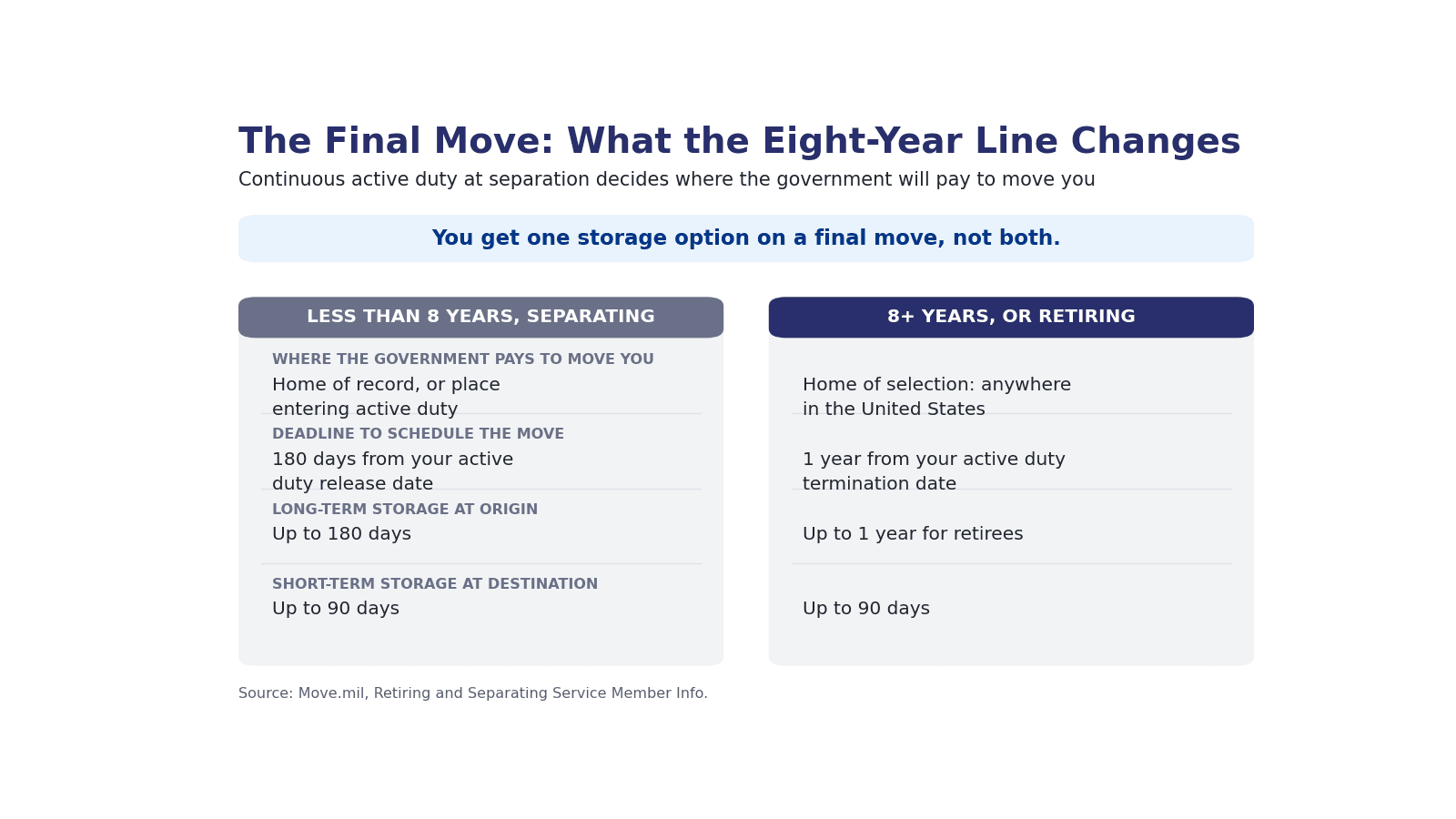
Where the government will move you, by years of continuous active duty. Source: Move.mil, Retiring and Separating Service Member Info.
The Deadline to Schedule
This is the single most common way families lose the benefit: they wait for life to settle and the window closes.
- Separating with less than eight years: schedule the move within 180 days of your active duty release date.
- Separating or retiring with more than eight years: schedule within one year of your active duty termination date.
Extensions exist, but they are not automatic and they are not granted for preference or convenience. Move.mil lists three grounds: medical treatment, education or training you are pursuing to qualify for civilian employment, and unexpected events you can document, such as legal proceedings or a delay in selling or building a home. Requests usually go by email to your branch of service. Generally, extensions can be requested in short intervals for no longer than six years, though each branch varies.
If you do not know where you are landing yet, request the extension early rather than letting the clock run.
You Only Get One Storage Option
On a normal PCS you can often use storage at both ends. On a final move, you pick one.
Long-term storage at origin. Non-temporary storage where you were last stationed, for up to 180 days for separating members and one year for retirees. If you have not scheduled final delivery before that expires, the additional storage is your bill. Our non-temporary storage guide covers what can and cannot go into the crate.
Short-term storage at destination. Storage in transit at your new location for up to 90 days, for both separating and retiring members. Blow past 90 days and you pay the excess, and you may also lose the ability to file a loss or damage claim with your military claims office. The 90-day SIT rules apply the same way they did on every other move.
Move.mil's own advice is direct: only use short-term storage at destination if you already know your final delivery address. If you are still house hunting, the 90 days will disappear faster than you expect.
This is the point where having an agent lined up before you separate pays for itself. A VeteranPCS agent in your target state can tell you realistically how long a purchase takes there, so you can pick the storage option that matches. Connect with one at no cost.
What Does Not Change
Three things carry over from every PCS you have already done.
Weight allowance. The amount you can move still depends on your final rank at separation or retirement. Check your figure in our 2026 weight allowance guide.
Professional gear. You can still move up to 2,000 pounds of professional books, papers, and equipment, and your spouse can still move up to 500 pounds.
Shipping method. You can let the government coordinate the whole move, do a personally procured move, or combine the two.
What Does Change: Your Vehicle
This one costs real money and catches people off guard. When you separate or retire, you drive or ship your vehicle at your own expense. There are no mileage allowances, no per diem, and no inability-to-drive allowance for the vehicle on a final move.